Professor Feedback Comment Templates That Save Time


Founder & CEO, Slashit App
You’re on essay twelve out of thirty five, and you’ve already typed some version of “your thesis needs to be more specific” four times tonight. By the time you hit essay thirty, you’re either rushing through feedback or copying the same three lines onto every paper regardless of what it actually needs. Neither helps your students, and both eat hours you don’t have.
A solid bank of professor feedback comment templates fixes this. You write each comment once, sort it by category, and reuse it whenever a paper needs it, tweaking a word or two for the student in front of you. It’s the same idea behind any rubric or answer key, just applied to the sentences you write instead of the scores you assign. This guide is built for instructors who grade in volume and want their feedback to stay sharp from the first paper to the last.
Below you’ll find a full comment bank organized by the issues that show up most often in student writing: thesis, evidence, structure, mechanics, and next steps. You’ll also get a simple process for building your own bank from your own courses, plus a system for turning it into something you can drop into any paper in a keystroke or two.
Why a Comment Bank Cuts Your Grading Time in Half
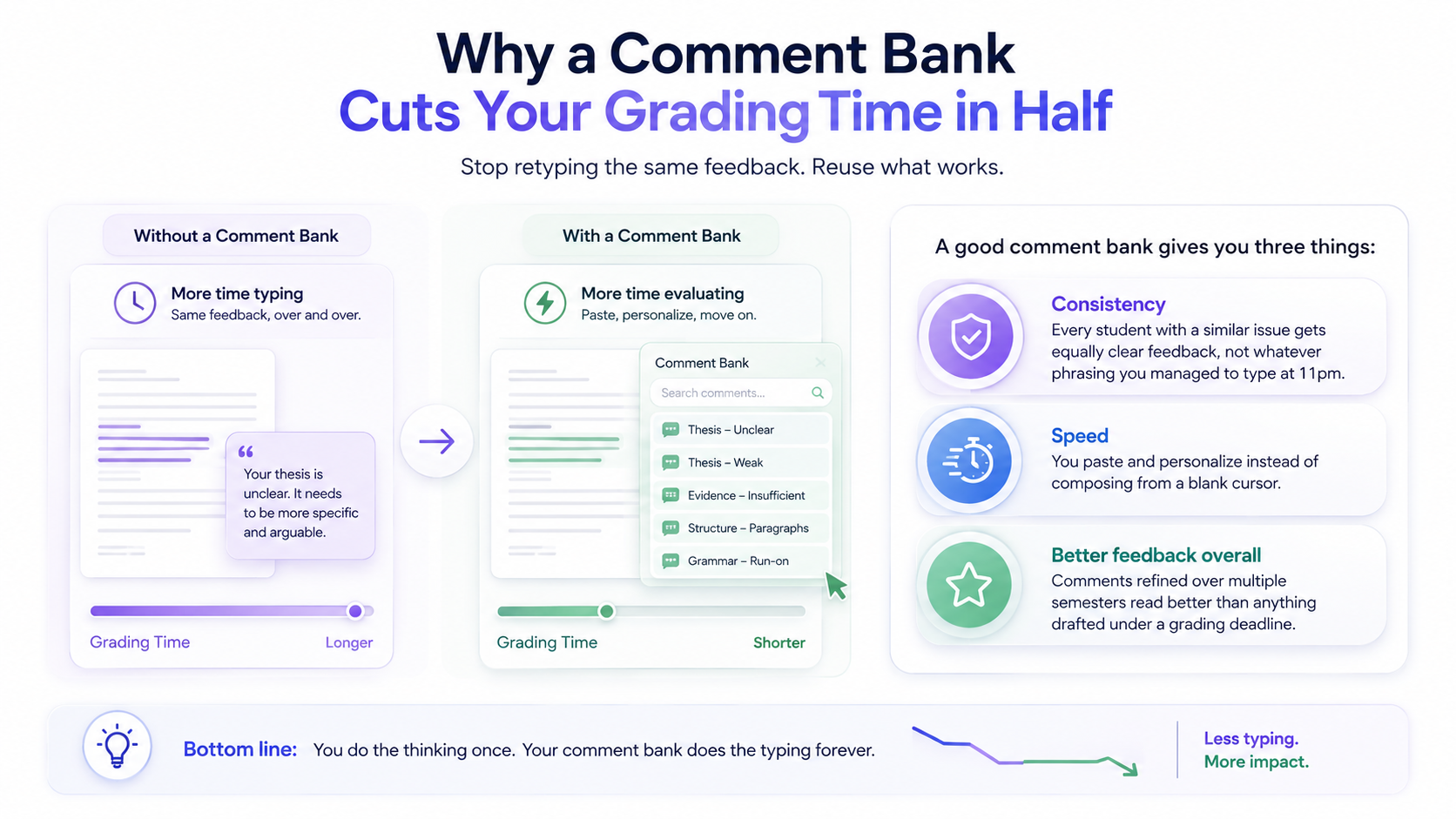
A comment bank saves time because it separates the thinking from the typing. Deciding what a paper needs is usually the easy part. Typing out the same explanation for the fifth time that week is what actually slows you down. Once you’ve written a strong version of a comment, you never have to build it from scratch again.
Instructors who grade in volume tend to notice the same pattern: comment writing eats more time than evaluation does. You already know what a weak thesis looks like the moment you read it. What takes time is finding the words to explain it clearly and kindly, every single time, especially late in a session when your patience for phrasing is running thin. Grading is far from the only repetitive writing task that quietly drains an instructor’s week, but it’s often the most draining one.
A comment bank also protects the quality of your feedback as the stack gets longer. Feedback tends to get shorter and vaguer toward the bottom of a pile, simply because fatigue sets in. When the wording is already written and ready to paste, essay thirty gets the same clear, specific comment as essay one.
A good comment bank gives you three things:
- Consistency. Every student with a similar issue gets equally clear feedback, not whatever phrasing you managed to type at 11pm.
- Speed. You paste and personalize instead of composing from a blank cursor.
- Better feedback overall. Comments refined over multiple semesters read better than anything drafted under a grading deadline.
Once the bank exists, the real savings come from how fast you can pull a comment into a document while you’re mid-grade. That’s where the categories below come in.
Thesis and Argument Feedback Comments
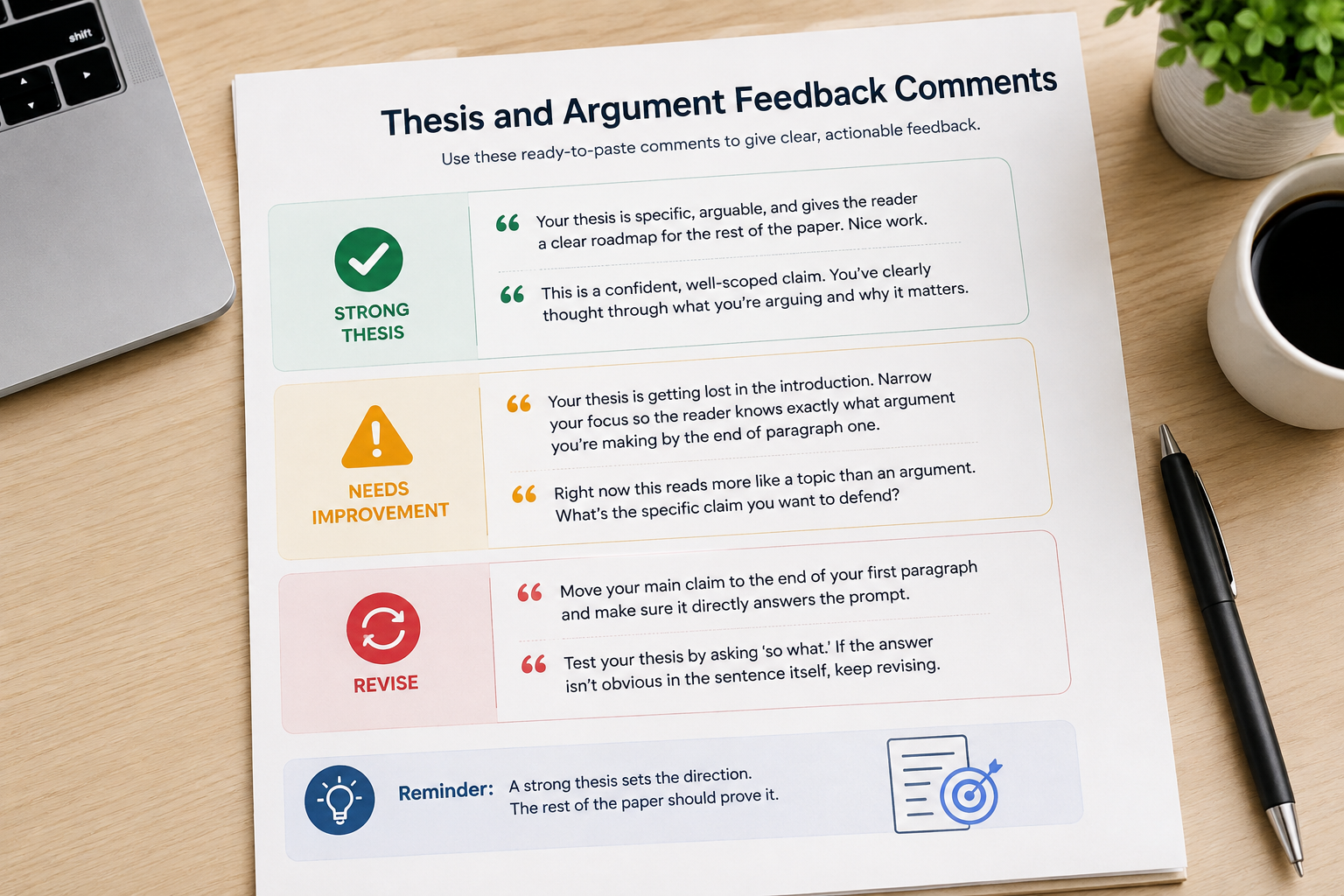
Thesis feedback should tell the student exactly what’s missing from their central claim, not just that something’s wrong with it. Thesis and argument problems show up in nearly every stack of papers, so this is the category you’ll reach for most. It’s worth keeping two or three variations of each comment on hand.
The templates below cover the three situations you’ll run into most often: a thesis that’s working well, one that’s present but unclear, and one that needs to be rebuilt from the ground up.
Strong thesis:
- “Your thesis is specific, arguable, and gives the reader a clear roadmap for the rest of the paper. Nice work.”
- “This is a confident, well-scoped claim. You’ve clearly thought through what you’re arguing and why it matters.”
Needs improvement:
- “Your thesis is getting lost in the introduction. Narrow your focus so the reader knows exactly what argument you’re making by the end of paragraph one.”
- “Right now this reads more like a topic than an argument. What’s the specific claim you want to defend?”
Revise:
- “Move your main claim to the end of your first paragraph and make sure it directly answers the prompt.”
- “Test your thesis by asking ‘so what.’ If the answer isn’t obvious in the sentence itself, keep revising.”
Once the thesis holds up, the next thing readers look for is whether the paper actually backs it up. That’s where evidence comes in.
Evidence and Analysis Feedback Comments
Evidence feedback should point out whether the student explained their sources or just dropped them in. This is where papers most often lose points, not for weak ideas, but for under-explained ones.
Here’s what strong versus weak evidence handling looks like, and the comment to use for each:
| Situation | What’s happening | Comment to use |
|---|---|---|
| Quote is well chosen and explained | Analysis follows every citation | ”Great use of primary sources. Your integration of quotes is smooth and the analysis right after each one is exactly what makes this persuasive.” |
| Quote is dropped in with no follow-up | Evidence present but unexplained | ”You’ve got good evidence here, but you need to explain how it supports your argument. Add one or two sentences of analysis after every quote.” |
| Evidence summarizes rather than argues | Paper restates the source instead of using it | ”This paragraph summarizes the plot more than it analyzes it. Connect this evidence back to your thesis directly.” |
| Evidence is strong but sourcing is thin | Only one source type used throughout | ”Consider bringing in a second type of source here. Right now you’re relying entirely on one perspective.” |
| Counterargument is missing | Paper doesn’t acknowledge an opposing view | ”Your argument would be stronger if you addressed the most obvious counterpoint. What would someone who disagrees say here?” |
Notice the pattern. Every comment names the specific gap and tells the student what to do next, not just what’s wrong. Moreover, that same principle carries into structure, where the issue is usually less about ideas and more about how they’re arranged on the page.
Structure and Organization Feedback Comments
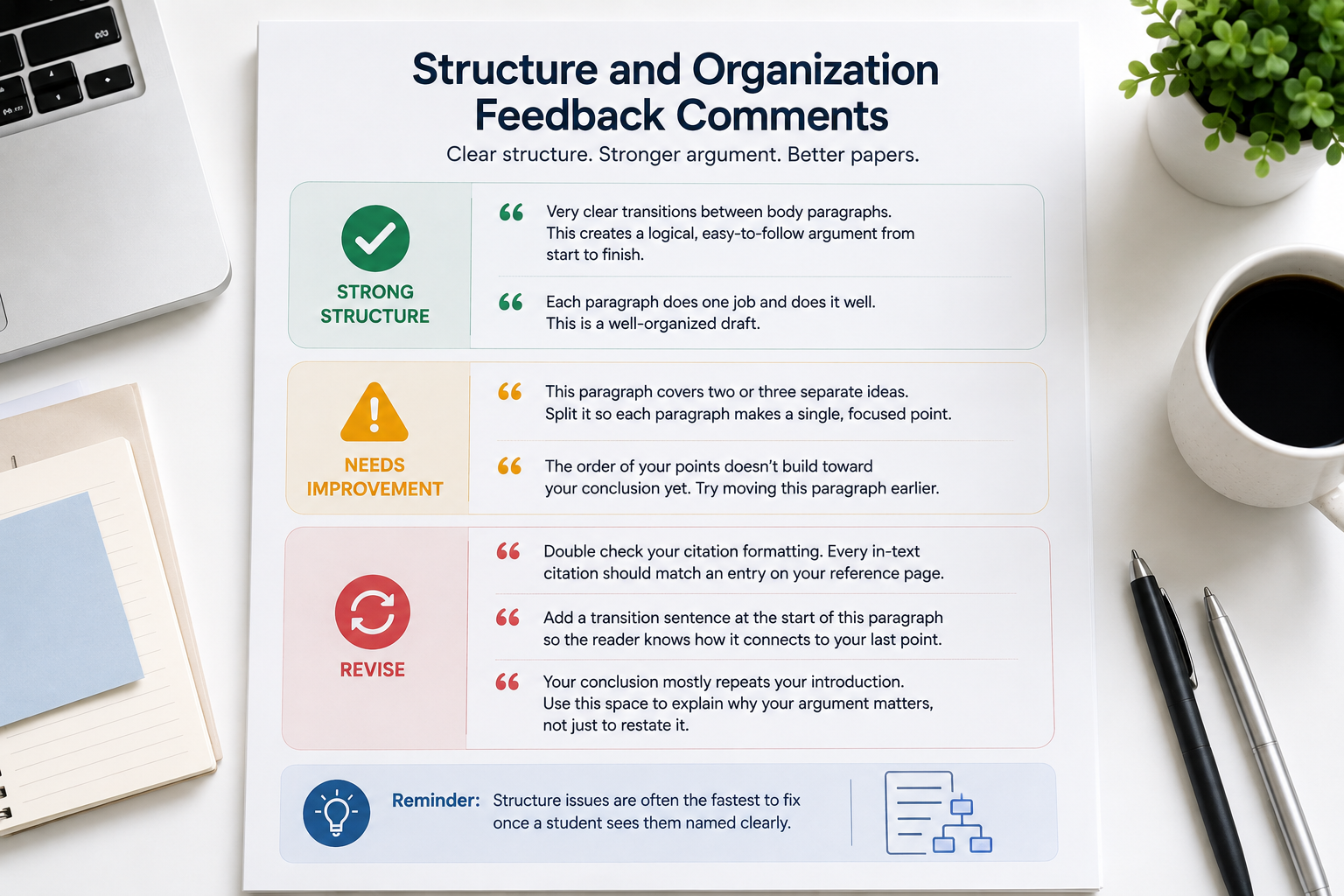
Structure feedback should point students to the exact paragraph or transition causing the confusion, not just tell them the essay “needs work.” Vague structural comments are the ones students ignore, simply because they don’t know where to start.
Strong structure:
- “Very clear transitions between body paragraphs. This creates a logical, easy-to-follow argument from start to finish.”
- “Each paragraph does one job and does it well. This is a well-organized draft.”
Needs improvement:
- “This paragraph covers two or three separate ideas. Split it so each paragraph makes a single, focused point.”
- “The order of your points doesn’t build toward your conclusion yet. Try moving this paragraph earlier.”
Revise:
- “Double check your citation formatting. Every in-text citation should match an entry on your reference page.”
- “Add a transition sentence at the start of this paragraph so the reader knows how it connects to your last point.”
- “Your conclusion mostly repeats your introduction. Use this space to explain why your argument matters, not just to restate it.”
Structure issues are often the fastest to fix once a student sees them named clearly. A saved comment beats a rushed one every time. From here, the next layer is the sentence-level work: grammar, style, and mechanics.
Grammar, Style and Mechanics Feedback Comments
Mechanics feedback should flag patterns, not just individual errors, so the student learns the rule instead of fixing one sentence. Marking every comma splice by hand is exhausting, and it’s mostly unnecessary once you’ve got a comment ready to go.
- “I’m noticing a pattern of comma splices throughout. Review the difference between a comma and a semicolon before your next draft.”
- “Watch your verb tense here. You shift between past and present within the same paragraph.”
- “This sentence is doing a lot of work. Consider breaking it into two for clarity.”
- “Passive voice is softening some of your strongest points. Try rewriting a few of these sentences in active voice and see how much more direct they feel.”
- “Proofread for word choice here. A stronger, more precise verb would sharpen this sentence.”
These comments land best when they point to one or two representative examples rather than marking every instance. Students generalize the fix faster that way. Once the mechanics are covered, close the loop with feedback that tells the student what to actually do with everything you just gave them.
Encouragement and Next-Steps Comments
Every set of feedback should end with a clear, specific next step, not just a grade and a goodbye. Students remember what to do differently far more when the last thing they read is actionable rather than generic praise.
- “You’ve shown a strong grasp of this material. Keep building on that analytical depth in your next assignment.”
- “Before you submit your next essay, bring your draft to office hours or the writing center so we can work through the thesis together.”
- “For your next paper, prioritize paragraph transitions and argument framing. That’s the biggest lever for improvement right now.”
- “This is strong, focused work. The main thing to carry forward is tightening your evidence-to-analysis ratio.”
- “Take a look at the feedback above before you start your next draft, and come find me if any of it doesn’t make sense.”
A closing comment like this turns a graded paper into a plan, and that’s really the whole point of feedback in the first place. Now that you’ve got a full bank across every category, the next question is how to build and organize one for your own courses.
How to Build Your Own Comment Bank in One Afternoon
Building your own comment bank takes less time than grading a single stack of essays, and it pays that time back on every assignment after. The templates above are a solid starting point, but the ones that save the most time are written in your own voice, about the issues that actually show up in your students’ work.
Here’s a simple process:
- Pull your last set of graded papers. Reread the comments you wrote and highlight anything you typed more than twice. Two or three graded stacks is usually enough to spot the patterns.
- Sort by category. Group comments into thesis, evidence, structure, mechanics, and next steps, the same buckets used above. Most instructors find their recurring comments cluster into just two or three categories, which tells you where to focus first.
- Rewrite the best version of each. For every recurring issue, write the clearest, kindest version of that comment once. This becomes your master copy, and it’s worth spending real time on since you’ll reuse it for semesters.
- Leave room to personalize. Build in a blank or a bracket where a student’s name, page number, or specific example should go, so the comment reads as written for them, not pulled from a list.
- Store it somewhere you’ll actually use. A comment bank buried in a document you never open won’t save you anything. It needs to live somewhere you can reach while you’re grading, without switching windows or breaking your flow. If writing from scratch feels daunting, a ready-made template library can give you a running start.
That last step is where most comment banks quietly fail. A pile of great comments only helps if pulling one into a paper takes seconds, not a search-and-copy-paste routine through three open tabs.
Turn Your Comment Bank into One-Keystroke Templates
The fastest way to use a comment bank is to type a short code instead of the full comment, and that’s exactly what a text expander does. Instead of keeping your templates in a separate document, you set each one up as a snippet inside Slashit.
Type /thesis1 and your full “narrow your focus” comment appears instantly, right inside Word, Google Docs, Canvas, or whatever platform your school uses for grading.
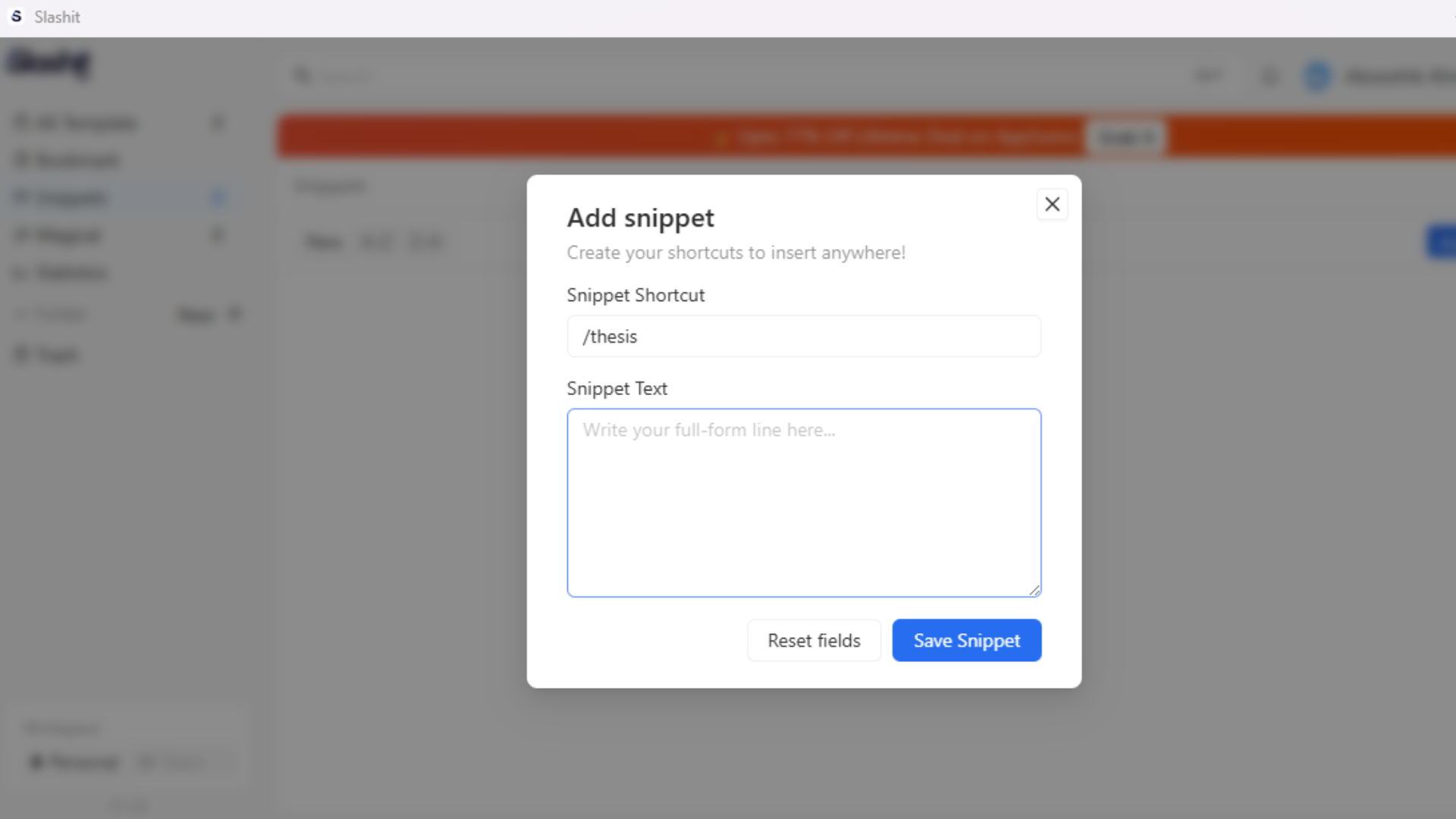
A few features make this a particularly good fit for grading feedback specifically:
- Dynamic templates. Build a comment with fillable fields, so /evidence2 expands into your full comment with a blank already positioned for the student’s name or the exact quote you’re referencing. You fill it in and move on.
- AI rewrite. If a comment feels slightly off for a particular student, an AI rewrite tool lets you soften, sharpen, or shorten it on the spot, without leaving the document or opening another tab.
- Clipboard history. Grading often means jumping between a rubric, a style guide, and the paper itself. Clipboard history keeps a record of what you’ve recently copied, so you can paste an earlier comment back in even after copying something else in between.
None of this replaces your judgment as a grader. That said, it removes the part where you’re retyping the same sentence for the fifteenth time. Once your comment bank lives in snippets, grading becomes reading and deciding, not typing.
Frequently Asked Questions
How long should professor feedback comments be?
Most effective comments run one to three sentences, long enough to name the issue and give a next step, short enough that students actually read them.
Should I use the same comment bank for every course?
Use it as a starting point, not a fixed script. Keep the categories consistent across courses, thesis, evidence, structure, mechanics, next steps, but adjust the wording for the level and discipline you’re teaching.
Can I build a comment bank inside Canvas or Turnitin directly?
Both platforms support saved comment libraries, but they’re locked to that specific tool. A text expander works across every platform you grade in, so you’re not maintaining separate banks for Canvas, Word, and email.
How many templates do I actually need?
Most instructors land somewhere between twenty and forty core comments once they’ve sorted their recurring feedback into categories. Start with the ones in this article, then add your own as patterns show up in your specific courses.
Does using template comments make feedback feel impersonal?
Not if you personalize each one before sending it. A template gives you the strong version of a comment. Adding the student’s specific example, page number, or context is what makes it feel individually written, and that part still takes seconds, not minutes.
What’s the difference between a comment bank and a rubric?
A rubric scores performance against fixed criteria. A comment bank is the language you use to explain that score. Most instructors use both together: the rubric decides the grade, and the comment bank explains the reasoning behind it in plain language.
Is it worth building a comment bank for a small class?
Even with fifteen students, the same handful of issues tend to repeat across papers. The time savings are smaller than with a lecture hall of two hundred, but writing each comment once instead of fifteen times still adds up over a semester.
Start Grading Faster Today
A good comment bank turns feedback from a nightly grind into a system you can trust, one that gets faster and sharper every semester you use it.
Start with the templates above and sort them into your own bank. When you’re ready to stop retyping the same lines paper after paper, try Slashit free and turn your comment bank into snippets you can drop into any document in seconds.
// more articles
 Productivity
 10 Best Grammarly Alternatives in 2026: Free and Paid
Comparing the best Grammarly alternatives for 2026 by price, AI customization, and use case, so you can find the right fit fast and skip the guesswork.
 Productivity
 Text Expander for Founders: Save Hours Every Week
A text expander for founders turns investor updates, cold outreach, and hiring replies into one hotkey. Compare tools, get templates, and set up in minutes.
 Productivity
 Text Expander for Managers: Stop Retyping the Same Messages
A text expander for managers turns repeated messages into instant shortcuts. See how tools like Slashit save managers hours every week.

// blog updates