5 Email Sequence Template for More Conversions

Founder & CEO, Slashit App
You send one email. Nobody buys. So you send another. Still nothing. Then you give up and tell yourself email marketing doesn’t work anymore.
Here’s the truth. It’s not your product. It’s not on your list. It’s the fact that you’re sending single emails when you should be sending a sequence.
A good email marketing sequence template does the heavy lifting for you. It builds trust email by email, so by the time you ask for the sale, your reader already feels like they know you.
In this guide, you’ll get a complete 5-email sequence template, the exact timing to use, subject lines that actually get opened, and the mistakes that quietly kill most sequences before they even get a chance to work.
Let’s get into it.
What Is an Email Marketing Sequence?
An email marketing sequence is a set of emails sent in a specific order, on a set schedule, to move a subscriber from “just signed up” to “ready to buy.” Each email has one job. Together, they build a relationship instead of just making noise.
Think of it like meeting someone new. You don’t propose marriage on the first date. You say hello, share a bit about yourself, spend time together, and only then talk about the future. A sequence follows that same natural rhythm, just through your inbox.
This is different from a single email blast, which is one message sent once, and different from a drip campaign, which usually reacts to specific actions a subscriber takes, like clicking a link or viewing a product page. A sequence, on the other hand, follows a set path from email one to the final email, no matter who’s reading it.
Once you understand what a sequence actually is, the next question is obvious. Why bother building one at all?
Why You Need an Email Sequence, Not Just One Email
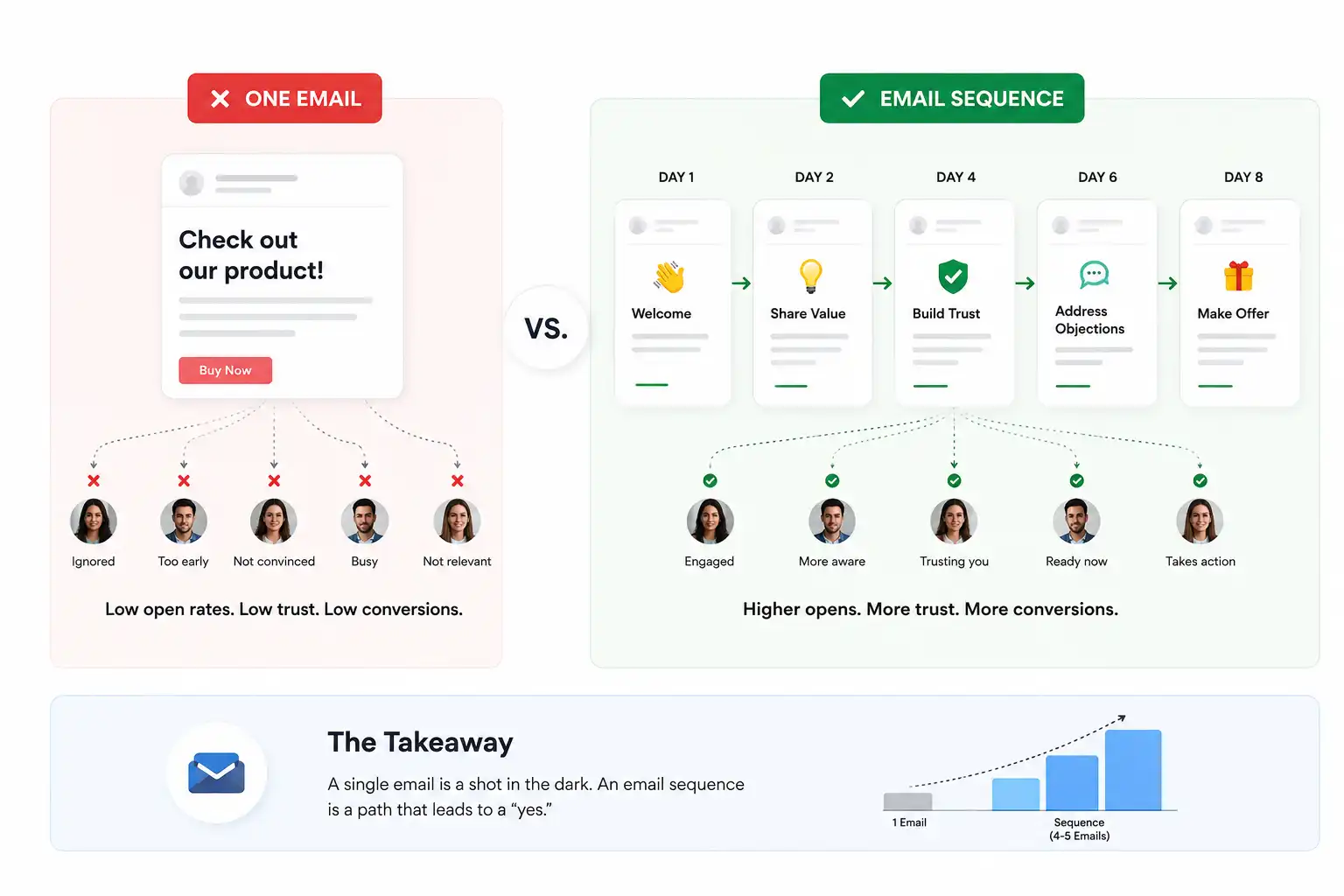
You need an email sequence because a single email rarely gets someone to act, but a well timed series of emails builds enough trust and context for them to say yes. People don’t buy from strangers. They buy from brands that feel familiar.
Here’s what the data backs up:
- Welcome sequences see far higher open rates than regular newsletters, often above 50 percent, because the subscriber just signed up and is still paying attention.
- Sequences that space out value before the pitch consistently convert better than one hard sell sent on day one.
- A structured sequence gives you 4 to 5 chances to earn a reply or a click, instead of betting everything on one message.
And there’s a simpler reason too. Not everyone is ready to buy the moment they sign up. Some need a day. Some need a week. A sequence meets people wherever they are in that timeline instead of forcing a decision too early.
Now that you know why sequences matter, let’s build the actual template you can use today.
The Universal Email Marketing Sequence Template (5-Email Breakdown)
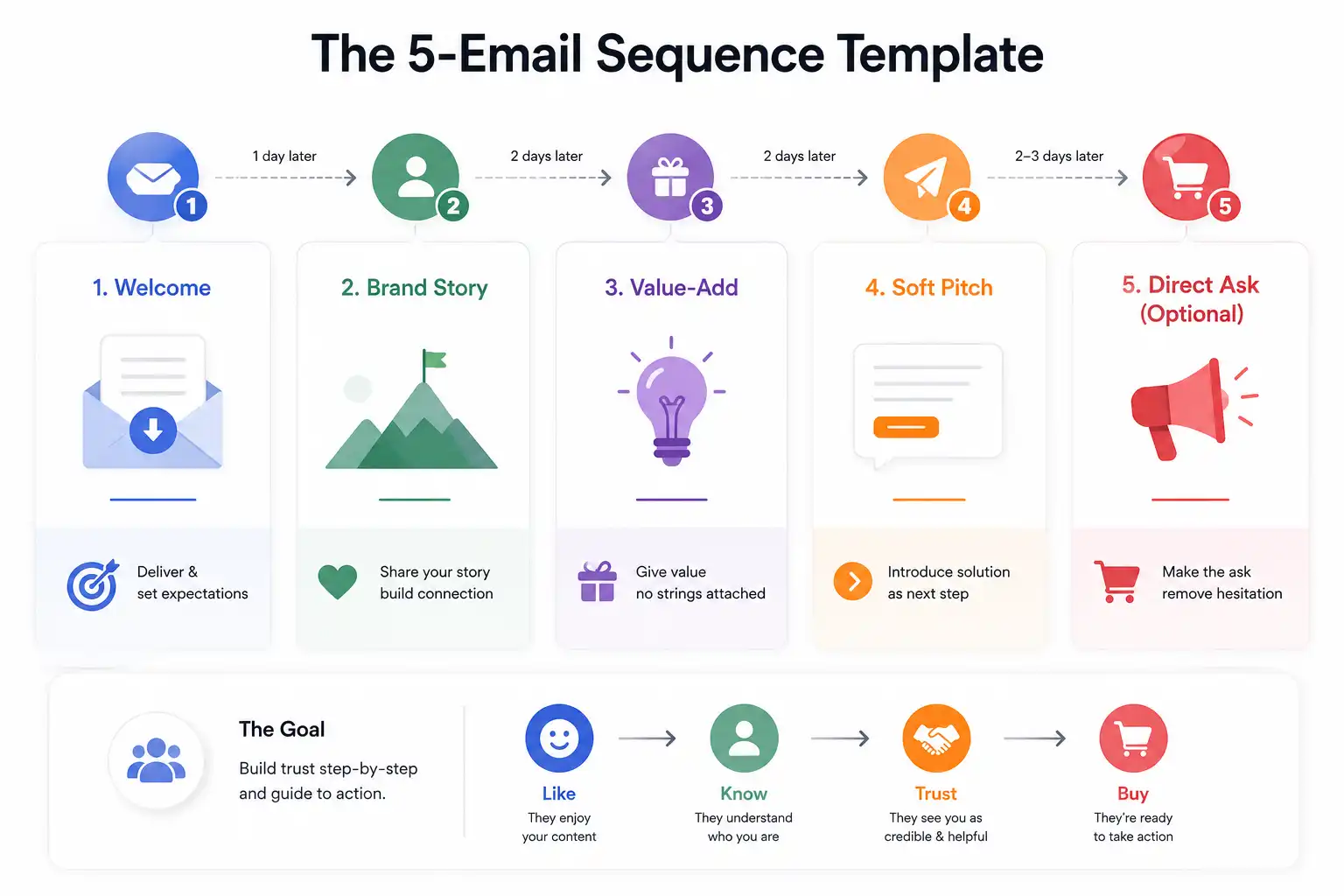
This email marketing sequence template works whether you’re welcoming a new subscriber, nurturing a lead, or guiding someone toward a paid offer. It’s built on five emails, each with one clear purpose, so nothing feels rushed and nothing gets repeated.
Here’s the order you’ll follow:
- Welcome and delivery
- Brand story
- Value-add email
- Soft pitch
- Direct ask (optional, use only if your goal is a sale)
Let’s break down each one.
Email 1: The Welcome and Delivery
Send this the moment someone joins your list, and its only job is to deliver what you promised and say a genuine thank you. Don’t sell anything here. Don’t even hint at it.
Subject line formula: Here’s your [freebie name], welcome to [brand name] What to include:
- The download link or access details, right at the top
- A short, warm thank you
- One line setting expectations (“Over the next few days, I’ll share…”)
Mini example: Hey Sarah, here’s your free guide, grab it right here. Thanks for joining. Over the next few days, I’ll share the story behind why we started this and a few tips you can use right away.
That’s it. Short, useful, and it makes the subscriber feel like they made the right call by signing up. Once they’ve got what they came for, it’s time to let them know who you actually are.
Email 2: The Brand Story
Send this one day after your welcome email, and its job is to share why your brand exists so the subscriber connects with you as a person, not just a company. This is where “like, know, trust” actually starts to form.
Subject line formula: Why we started [brand name], and why it matters to you What to include:
- The problem you personally faced before building this
- What frustrated you enough to do something about it
- How that struggle shaped what you offer today
Mini example: A few years back, I was stuck doing the same repetitive task every single day. No tool fixed it the way I needed, so I built one. That frustration is exactly why [brand] exists.
Stories stick where sales pitches slide right off. This email doesn’t sell a thing, but it quietly builds the trust that makes the next email land better.
Email 3: The Value-Add Email
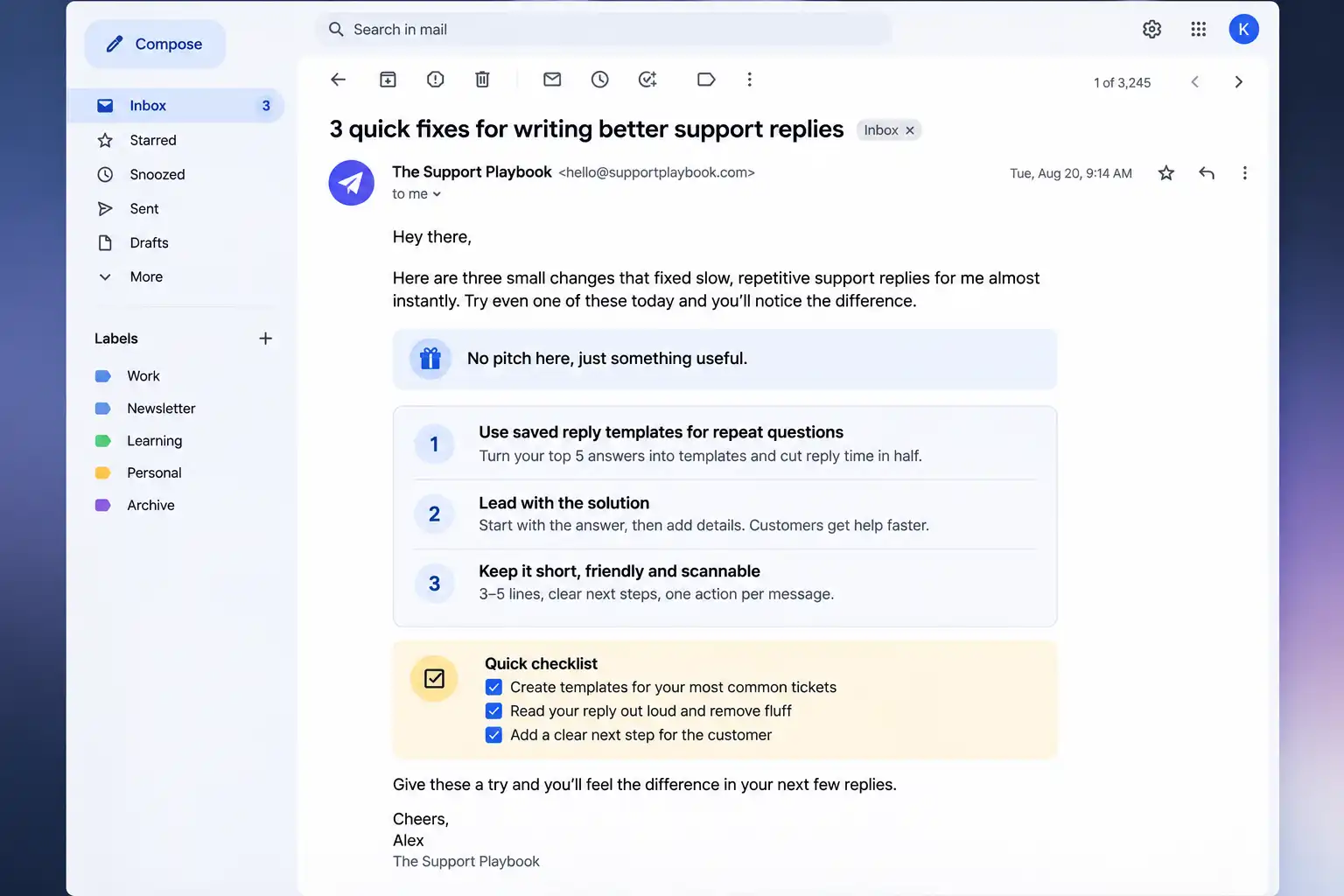
Send this two days after your brand story, and its job is to give real, useful help with zero strings attached. No mention of your product yet. This email exists purely to make the subscriber’s life a little easier.
Subject line formula: 3 quick fixes for [common pain point] What to include:
- Your single best tip related to the problem your audience faces
- A short walkthrough or checklist they can use immediately
- A line that says “no pitch here, just something useful”
Mini example: Here are three small changes that fixed [common pain point] for me almost instantly. Try even one of these today and you’ll notice the difference.
This is the email that makes people think, “if this is what they give away for free, imagine what the paid version looks like.” That thought is exactly what sets up your next email.
Email 4: The Soft Pitch
Send this two days after your value-add email, and its job is to introduce your paid offer as the natural next step, not a hard sell. You’ve earned the right to mention it now.
Subject line formula: Ready to take this further? What to include:
- One clear benefit of your product, not a full feature list
- A light, low-pressure mention of what it does
- A single call to action button or link
Mini example: If those tips helped, you’ll love what [product] does with the heavy lifting for you. It’s built for exactly this problem, and here’s where you can check it out.
Keep this light. You’re planting a seed here, not asking for a decision on the spot. If your goal is a direct sale rather than just a warm welcome, there’s one more email worth adding.
Email 5: The Direct Ask (Optional Hard Sell)
Send this only if your sequence is built for conversion, two to three days after your soft pitch, and its job is to ask clearly for the sale while addressing the hesitation that’s likely still there. This step isn’t needed for a pure welcome sequence, but it’s essential for sales-focused funnels.
Subject line formula: Last call, here’s what you get with [product] What to include:
- A quick reminder of the pain point you’ve been solving throughout the sequence
- A clear explanation of what your product does and who it’s for
- A direct link to your offer page, plus urgency if you have a real reason for it, like a limited bonus
Mini example: You’ve seen what’s possible with a few small tips. Now imagine that same relief, but automatic. That’s what [product] does. Here’s the link, and here’s exactly what you get.
If your team runs a lot of these sales-heavy sequences, it helps to have a system built for the sales side of things, since repeating the same pitch structure across different leads gets old fast without one.
With all five emails mapped out, the next piece that decides whether this works is timing.
Email Sequence Timing and Cadence
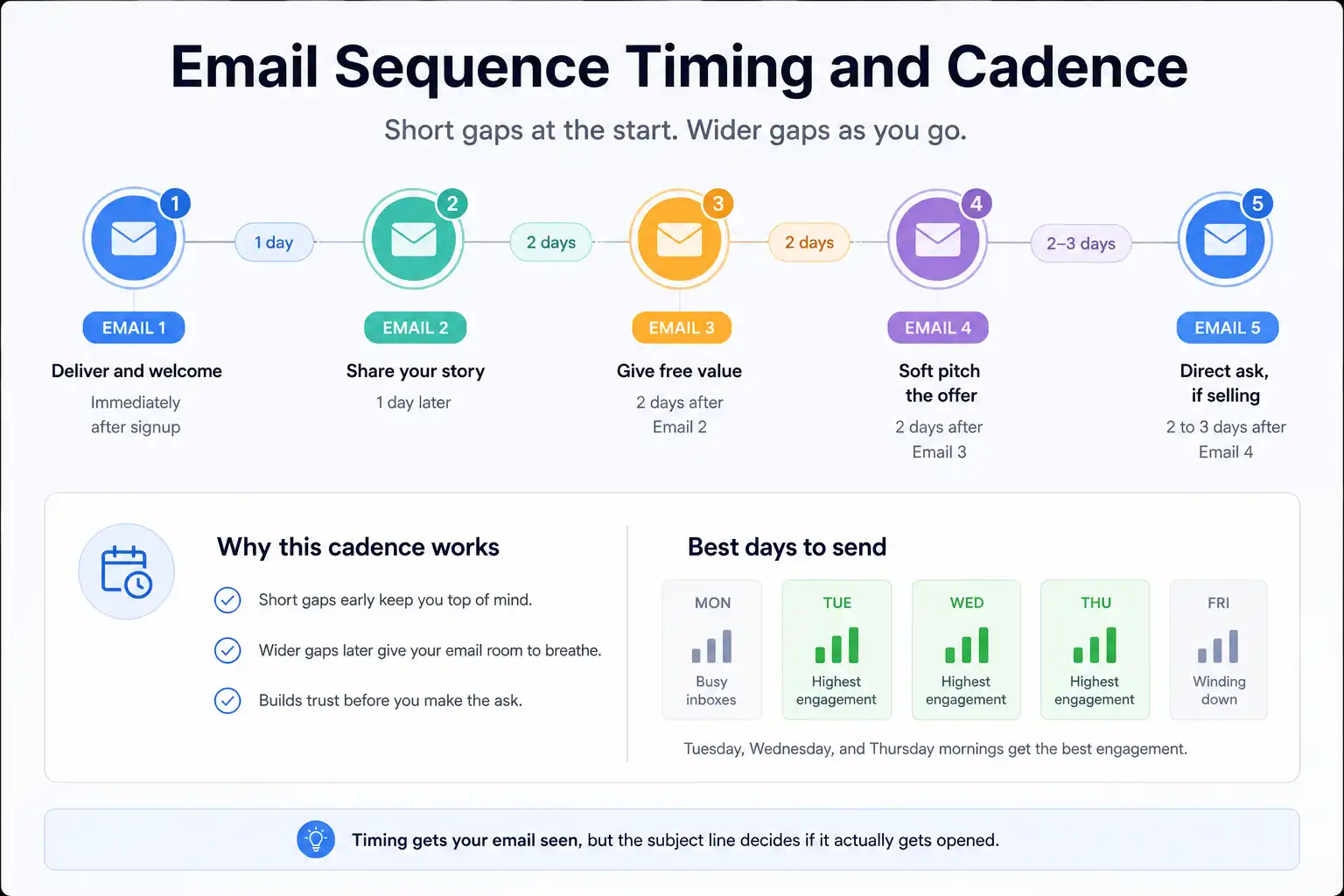
The right cadence for an email sequence is to start with short gaps between emails and gradually widen them as the sequence goes on. Send too fast and you look desperate. Space it out too much and people forget who you are.
Here’s the cadence that works for most 5-email sequences:
| Send Timing | Purpose | |
|---|---|---|
| Email 1 | Immediately after signup | Deliver and welcome |
| Email 2 | 1 day later | Share your story |
| Email 3 | 2 days after Email 2 | Give free value |
| Email 4 | 2 days after Email 3 | Soft pitch the offer |
| Email 5 | 2 to 3 days after Email 4 | Direct ask, if selling |
Notice the pattern. The gap between emails 1 and 2 is short because the subscriber is still fresh and paying attention. By the time you get to email 5, you’ve given them a bit more breathing room, so the ask doesn’t feel rushed.
And one more thing worth knowing, Tuesday, Wednesday, and Thursday mornings tend to get the best engagement, since Mondays are cluttered and Fridays are already winding down. Timing gets your email seen, but the subject line decides if it actually gets opened.
How to Write Subject Lines That Get Opened
A good subject line for an email sequence is short, specific, and sounds like it’s written for one person, not a mailing list. Keep it under 6 to 8 words whenever you can.
A few formulas that consistently work:
- The direct benefit: “Here’s your [freebie], welcome aboard”
- The curiosity gap: “Why we started [brand]”
- The quick fix: “3 ways to fix [pain point]”
- The soft nudge: “Ready for the next step?”
Avoid anything that sounds like a mass blast, like “Amazing offer inside” or “Don’t miss out.” These trigger both spam filters and reader skepticism at the same time. A sharp subject line gets the email opened. But writing five of these, personalized for every segment you send to, is where most people quietly run out of steam.
How to Write a Sequence Fast Without Sounding Robotic
The fastest way to write a full email sequence without burning your whole week is to build reusable templates for each email type instead of writing from scratch every single time. This is the part nobody talks about, but it’s the actual bottleneck for most marketers and founders.
Here’s what usually happens. You write a great welcome email once. Then next month, you’re launching a new lead magnet, and you’re rewriting that same welcome email from memory, tweaking a name here, a product there, hunting through old email threads to find that one line that worked so well last time.
That’s hours lost to typing the same structure over and over. A dynamic template fixes this. You build the welcome email, the brand story opener, and the soft pitch closer once, with blanks for the name, product, and offer, and then you fill in the blanks in seconds every time you launch a new sequence.
It doesn’t stop at templates either. If you’ve got a great line from a past campaign buried somewhere in your old emails, clipboard history means you don’t have to go digging for it. And when the same paragraph needs to sound more casual for one segment and more formal for another, an AI rewrite tool adjusts the tone in a click instead of you rewriting the whole thing by hand.
This matters even more if you’re a marketer running five or six sequences at once for different products or audiences. The template stays the same. Only the details change. Once your writing process is fast, the next thing to protect is the sequence itself, so it doesn’t fall apart from a few common mistakes.
Common Email Sequence Mistakes to Avoid
The biggest mistake in email sequences is pitching too early, before the subscriber has any reason to trust you yet. Here are the ones that quietly kill conversions:
- Selling in email 1 or 2. Nobody bought anything from a stranger’s second message. Earn it first.
- Cramming multiple CTAs into one email. One idea, one action, every single time.
- Sending every email at the exact same hour. It looks automated, and both spam filters and readers notice.
- Skipping the story email. Facts convince the brain, but stories are what people actually remember.
- Never testing subject lines. A small tweak in wording can shift your open rate more than you’d expect.
- No plan for cold subscribers. If someone doesn’t open any of your five emails, you need a separate re-engagement path, not silence.
Fix these and your sequence stops leaking subscribers at every step. Now let’s pull everything together into one quick checklist you can actually use.
Email Marketing Sequence Checklist
Before you hit send on your next sequence, run through this list:
- Email 1 delivers the promised freebie immediately
- Email 2 shares a real, honest brand story
- Email 3 gives away genuine value with no pitch attached
- Email 4 softly introduces your offer with one clear benefit
- Email 5 (if selling) makes a direct, clear ask
- Cadence follows a widening gap, from 1 day to 2 to 3 days apart
- Every subject line is under 8 words and sounds personal
- Each email has exactly one call to action
Keep this list next to you every time you build a new sequence, and you’ll rarely miss a step. A few of the most common questions still trip people up though, so let’s clear those up.
Frequently Asked Questions
How many emails should be in an email sequence?
Most email sequences work best with 4 to 5 emails. Fewer than that and you’re pitching too soon. More than that and you risk losing attention or looking pushy. If you run out of new value to add by email 5 or 6, that’s usually a sign your sequence is already long enough.
How long should an email sequence run?
A typical 5-email sequence runs across 7 to 10 days, spaced with widening gaps between each send. Sales-heavy sequences for higher priced offers can stretch a bit longer, sometimes 2 to 3 weeks, to give the reader more time to decide.
What’s the difference between an email sequence and a drip campaign?
An email sequence follows the same fixed order for every subscriber, while a drip campaign usually triggers based on specific actions someone takes, like clicking a link or visiting a pricing page. Sequences are simpler to set up. Drip campaigns are more personalized but need more setup work.
What’s a good open rate for an email sequence?
A healthy open rate for a welcome or nurture sequence sits above 40 to 50 percent, especially for the first email, since the subscriber just signed up and is still engaged. Open rates naturally drop a bit with each following email, and that’s normal.
Do I need different tools to write and send my sequence?
Writing and sending are two separate jobs, and it helps to treat them that way. Your email service provider handles scheduling and delivery, while a text expansion and template tool handles the actual writing, so you’re not retyping the same welcome line or brand story for every new campaign. If you’re a founder wearing five hats at once, having the writing side handled quickly frees up real time for everything else on your plate.
Final Thoughts
A great email marketing sequence template isn’t about clever tricks. It’s about earning attention one honest email at a time, then asking clearly once you’ve earned it. Welcome, story, value, soft pitch, and if it fits your goal, a direct ask. That’s the whole formula.
Now go build yours. And if writing five personalized emails for every new campaign sounds like the most exhausting part of this whole process, give Slashit a try and see how much faster that part gets.
// more articles
 Productivity
 10 Best Grammarly Alternatives in 2026: Free and Paid
Comparing the best Grammarly alternatives for 2026 by price, AI customization, and use case, so you can find the right fit fast and skip the guesswork.
 Productivity
 Text Expander for Founders: Save Hours Every Week
A text expander for founders turns investor updates, cold outreach, and hiring replies into one hotkey. Compare tools, get templates, and set up in minutes.
 Productivity
 Text Expander for Managers: Stop Retyping the Same Messages
A text expander for managers turns repeated messages into instant shortcuts. See how tools like Slashit save managers hours every week.

// blog updates