Content Marketing Brief Template: The Complete Guide


Founder & CEO, Slashit App
You open a blank document. Your editor dropped a topic in your inbox an hour ago. No target audience. No keyword. No word count. Just a title and a deadline sitting there.
That gap between an idea and a finished draft is where good content quietly falls apart. A content marketing brief template closes that gap before a single word gets written.
Most writers have lived through both sides of this. A brief that says everything leaves nothing to figure out, and the draft comes back close to right on the first try. A brief that says nothing sends three rounds of confused revisions back and forth before anyone lands on what the piece was supposed to say in the first place.
This guide covers exactly what belongs in a content marketing brief template, why it matters, and how to build one you will actually use for every piece you plan. You will also get a free, copy-ready template near the end, along with a quick example of what a filled-in brief looks like in practice.
What Is a Content Marketing Brief?
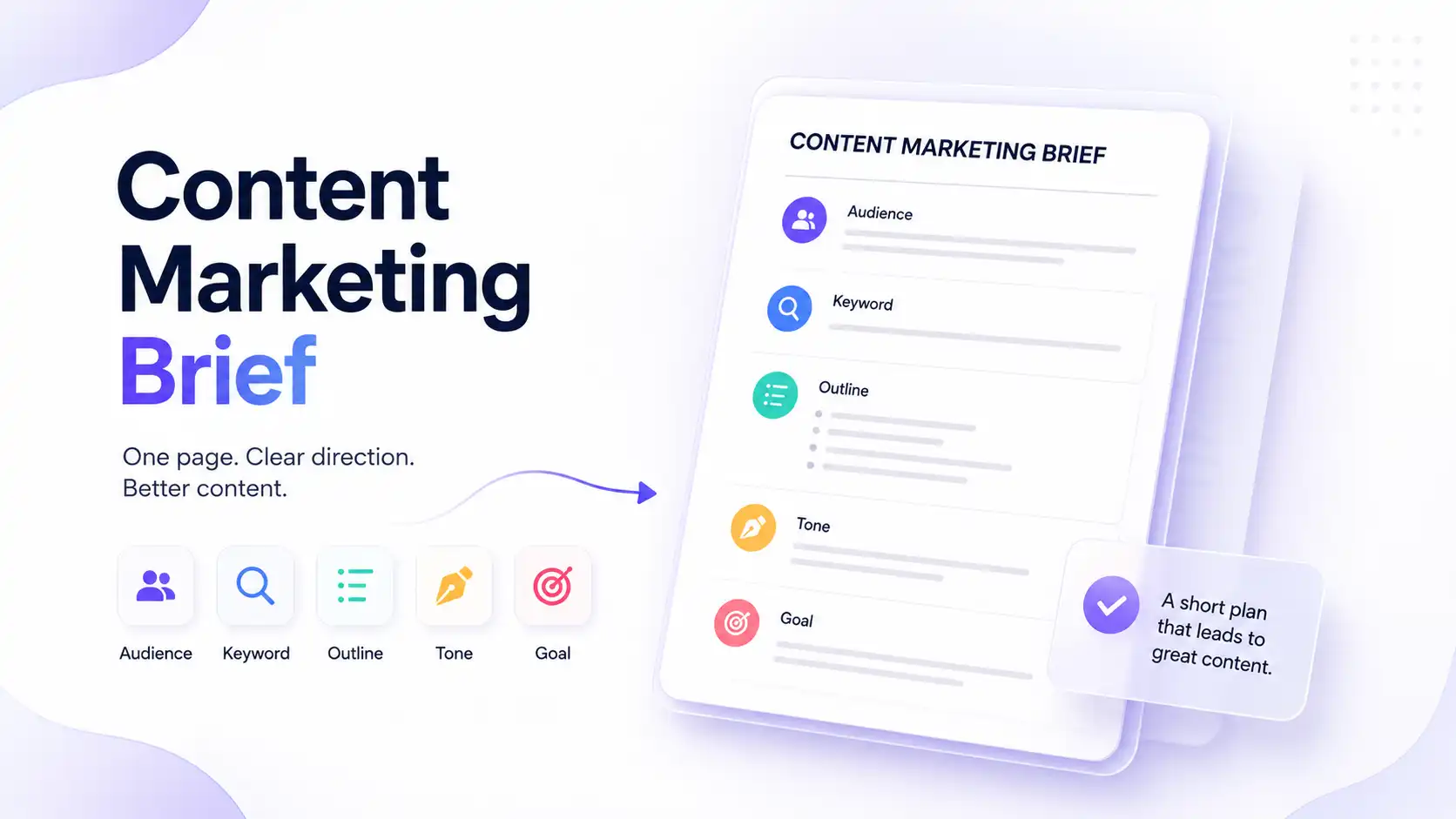
A content marketing brief is a short planning document that tells a writer exactly what to create before they start writing. It packs the audience, the keyword, the outline, the tone, and the goal into one page instead of scattering that information across emails and Slack threads.
Good briefs stay short on purpose. One to two pages is the sweet spot. Anything longer starts to feel like a rulebook, and writers stop reading past page one.
A brief is also a guide, not a straightjacket. It tells a writer what the piece needs to cover and why, and then gets out of the way so they can actually write.
Once you know what a brief covers, the next question is how it differs from two documents people often confuse it with.
Content Brief vs. Creative Brief vs. Content Outline
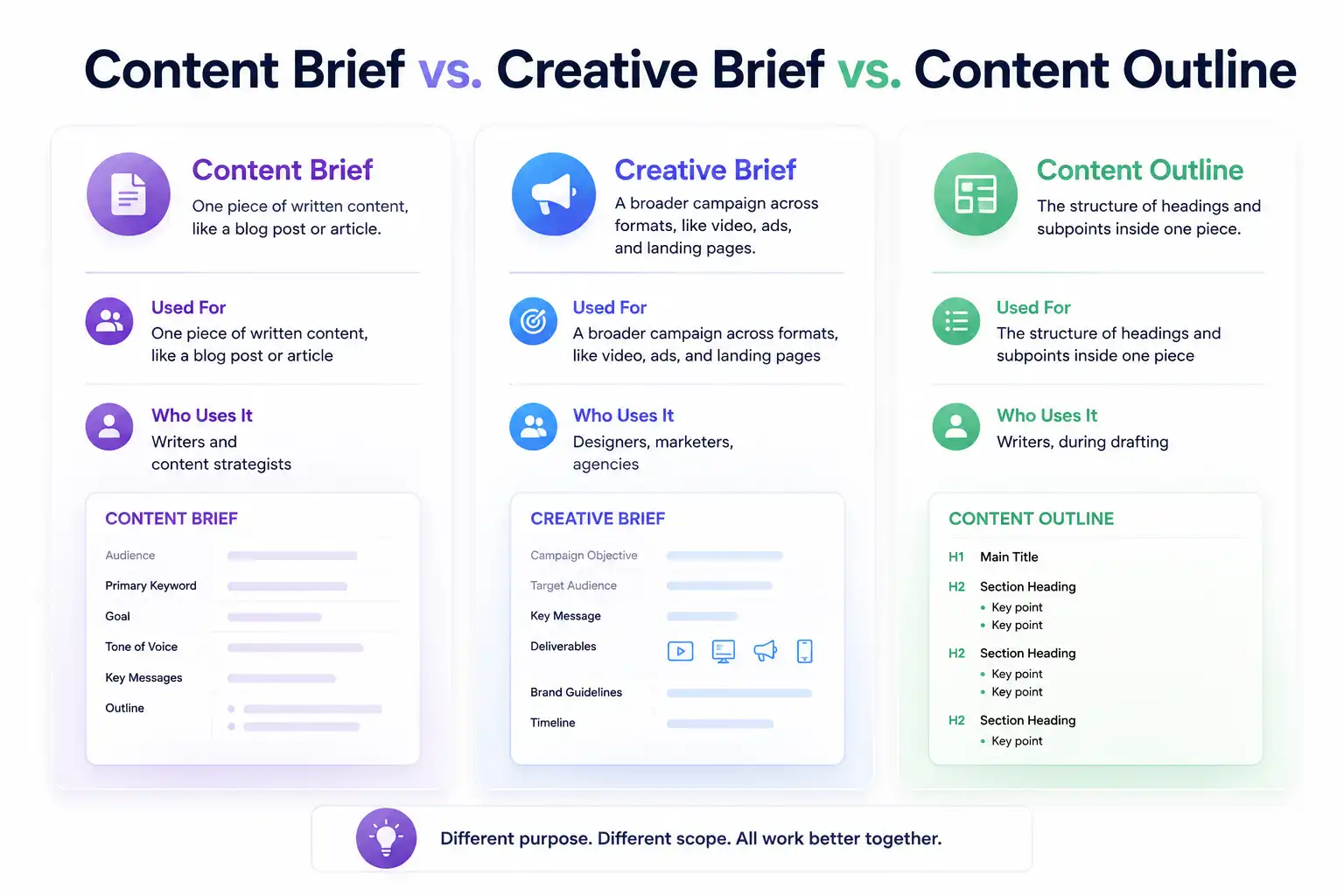
A content brief, a creative brief, and a content outline solve three different problems, even though people use the names interchangeably all the time.
| Document | Used For | Who Uses It |
|---|---|---|
| Content brief | One piece of written content, like a blog post or article | Writers and content strategists |
| Creative brief | A broader campaign across formats, like video, ads, and landing pages | Designers, marketers, agencies |
| Content outline | The structure of headings and subpoints inside one piece | Writers, during drafting |
A creative brief is the widest of the three. It might cover messaging for a video, a landing page, and a social campaign all at once. A content brief is narrower and more tactical, built for a single article or page. The content outline is narrower still. It usually lives inside the brief as one section, not as a separate document on its own.
With the terms sorted out, here is why teams that publish consistently rely on a brief template instead of starting from scratch every time.
Why Content Marketing Teams Need a Brief Template
A brief template saves time, cuts revisions, and keeps every writer working from the same standard. Without one, each writer fills the gaps with guesswork, and every guess is a little different.
New writers ramp up faster too. Hand someone a filled-out template on day one, and they understand your audience, your voice, and your linking habits without three rounds of feedback. That structure also keeps SEO and brand voice aligned, since the keyword and tone notes sit in the same document instead of two separate ones.
In practice, teams that reuse the same brief structure tend to see fewer first-round revisions, simply because the writer is not guessing what the editor actually wanted.
That matters most for marketing teams publishing on a tight weekly schedule, where reinventing the process every time is not realistic. Heavy publishing calendars are exactly why marketing teams build their entire workflow around a repeatable brief instead of a blank doc.
Once you understand why a brief template pays off, the next step is knowing exactly what to put inside one.
Key Elements of a Content Marketing Brief Template
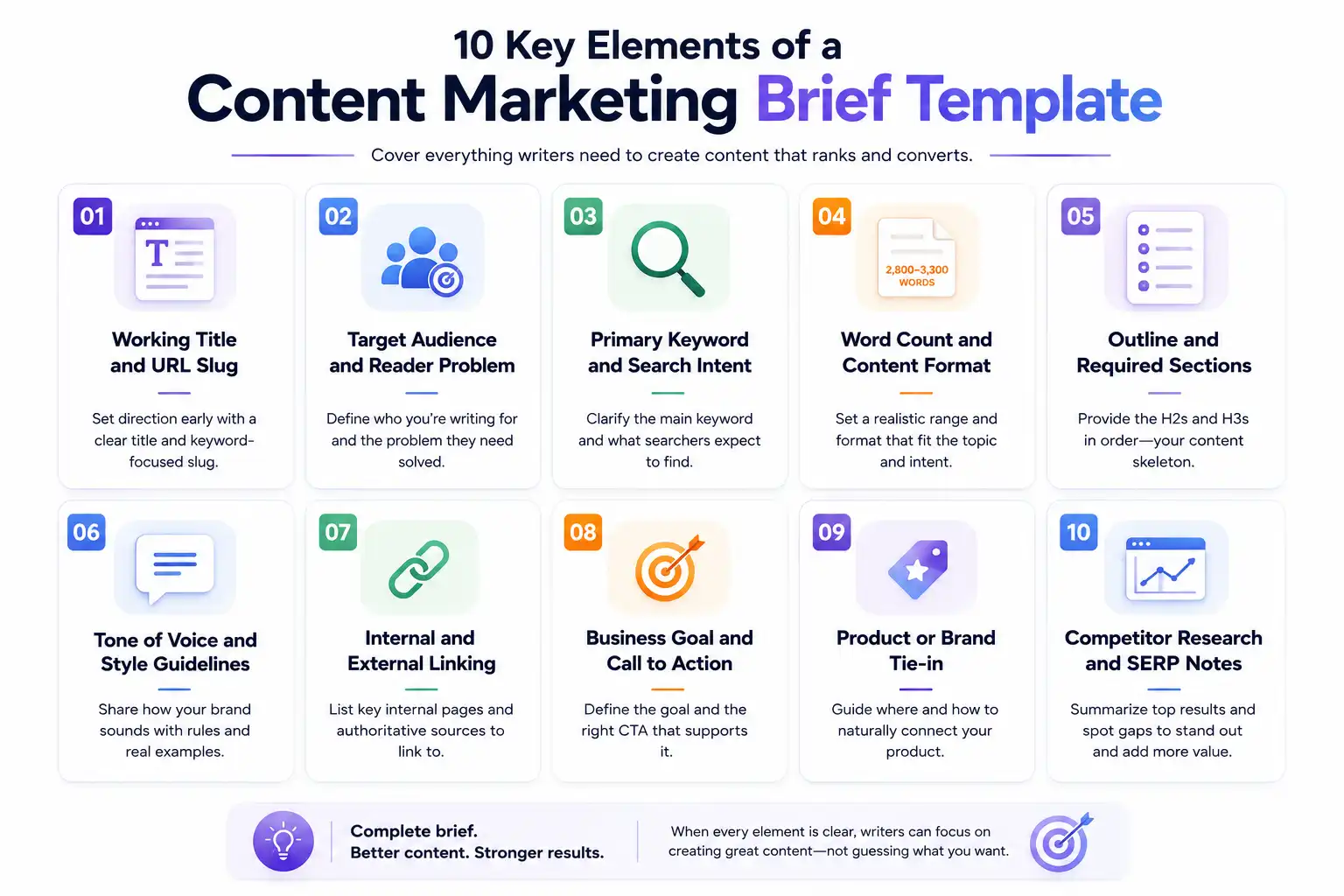
A strong content marketing brief covers ten core elements, from the working title to competitor research. Skip any of these, and the writer ends up filling the blank with their own assumption, which may not match what you actually wanted.
Working Title and URL Slug
Every brief starts with a working title and a suggested URL slug. Neither has to be final. Both give the writer a clear direction and a sense of where the primary keyword should sit. A working title like “Content Brief Guide” tells the writer almost nothing, while “Content Marketing Brief Template: The Complete Guide” tells them the format, the depth, and the keyword all at once.
Target Audience and Reader Problem
The brief should name exactly who the piece is for and what problem brought them here. “Marketers” is too broad. “A content marketer at a small team who has no formal brief process” is specific enough to write toward, because it tells the writer what the reader already knows and what they are missing.
Primary Keyword and Search Intent
Every brief needs one primary keyword and a clear read on what the searcher actually wants. Someone searching a definition wants a fast answer near the top. Someone searching a template wants something they can copy immediately.
Mixing up the two intents is one of the fastest ways to write an article nobody finishes reading, since the structure ends up fighting what the reader actually came for.
Word Count and Content Format
A realistic word count range keeps the writer from overwriting or underdelivering. A range like 2,800 to 3,300 words works better than a hard number, since the goal is a complete answer, not a word quota to hit. Format matters just as much as length. A comparison post, a how-to guide, and a definition page all need different structures even at a similar word count.
Outline and Required Sections
The outline lists every H2 and H3 the piece needs, in order. It works as the skeleton from the earlier comparison, the part of the brief that keeps structure consistent even when different writers handle different articles. A shared outline format also makes it easy to spot when a writer skipped a section the brief called for.
Tone of Voice and Style Guidelines
Tone guidelines tell the writer how the brand actually sounds, not just how a style guide says it should sound. Contractions okay or not okay, jargon allowed or banned, first person or not, all belong here in a couple of quick lines.
Real examples work better than abstract adjectives. A single sample sentence in the house voice teaches a new writer more than three paragraphs describing that voice ever could.
Internal and External Linking
A good brief lists where to link internally and which outside sources back up any claims. Two to four internal links and one or two external, authoritative sources is a reasonable target for most blog-length pieces.
Naming the exact pages in advance also keeps the writer from linking randomly or skipping links entirely because they ran out of time at the end.
Business Goal and Call to Action
Every piece needs one clear goal, whether that is organic traffic, lead generation, or building trust with a specific audience. The call to action should match that goal instead of defaulting to a generic “sign up now” line that ignores what the reader just spent ten minutes learning.
Product or Brand Tie-in
If there is a natural place to mention your own product, the brief should flag it instead of leaving the writer to force it in later. A tie-in works when it solves a problem the reader already has in that section, not when it interrupts one. The best tie-ins read like a helpful suggestion, not an ad break in the middle of useful advice.
Competitor Research and SERP Notes
A quick look at what is already ranking shows the writer what to match, and more importantly, what competitors missed. That gap is usually the most interesting part of the article, since it is the one angle nobody else on the results page has covered yet.
| Element | What It Covers |
|---|---|
| Working title and slug | Direction for the piece and the URL |
| Target audience | Who reads it and their specific problem |
| Primary keyword | Search term and search intent |
| Word count | A realistic length range |
| Outline | Required headings, in order |
| Tone and style | Brand voice guidelines |
| Linking | Internal and external references |
| Goal and CTA | What success looks like |
| Product tie-in | Where a natural mention fits |
| Competitor notes | What is ranking and what is missing |
With those elements in hand, you are ready to see what a filled-out brief actually looks like.
Free Content Marketing Brief Template You Can Copy and Paste
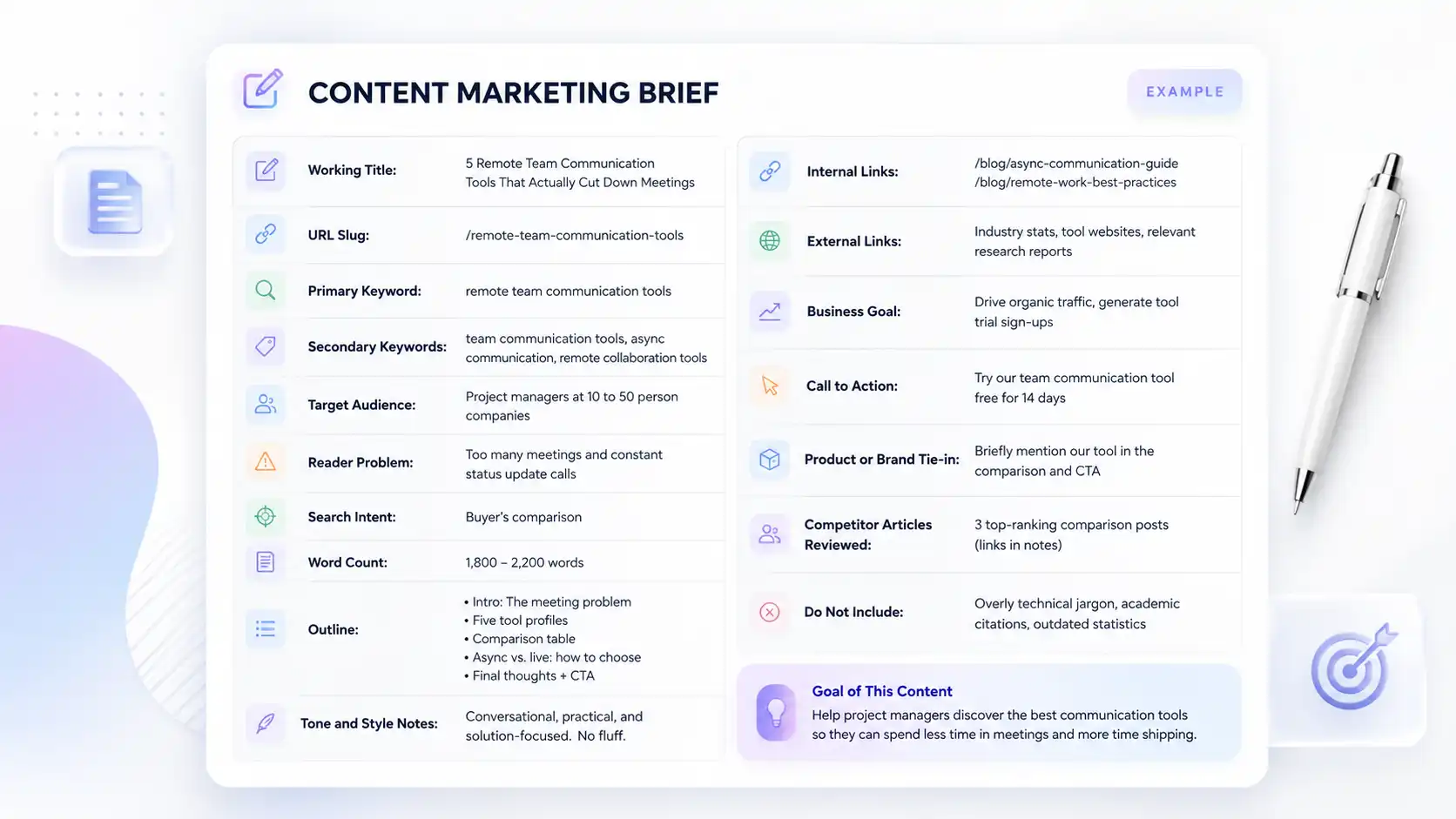
Copy this content marketing brief template into a blank doc and fill in each field before your next assignment.
Working Title: URL Slug: Primary Keyword: Secondary Keywords: Target Audience: Reader Problem: Search Intent: Word Count: Outline: Tone and Style Notes: Internal Links: External Links: Business Goal: Call to Action: Product or Brand Tie-in: Competitor Articles Reviewed: Do Not Include:
Keep it to one page whenever you can. Add or remove fields depending on the content type. A thought leadership piece might need a point-of-view field, and a comparison post might need a features table instead of a standard outline.
What a Filled-In Brief Looks Like in Practice
A filled-in brief reads like a short set of instructions, not a wall of theory. Below is a shortened example for a piece on remote team communication.
The working title reads “5 Remote Team Communication Tools That Actually Cut Down Meetings.” The audience line names project managers at 10 to 50 person companies who are drowning in status update calls. The primary keyword is “remote team communication tools,” with search intent marked as a buyer’s comparison rather than a pure definition. The outline calls for five tool profiles, a short comparison table, and a closing section on choosing between async and live communication.
Notice what the brief does not do. It does not write the article’s opening line, and it does not dictate every sentence under each tool profile. It gives the writer a target and lets them hit it in their own words. That balance, specific enough to remove guesswork, open enough to leave room for good writing, is what separates a brief that gets used from one that gets ignored.
Once you have the fields filled in, follow this order to turn them into a finished brief without missing anything.
How to Write a Content Marketing Brief Step by Step
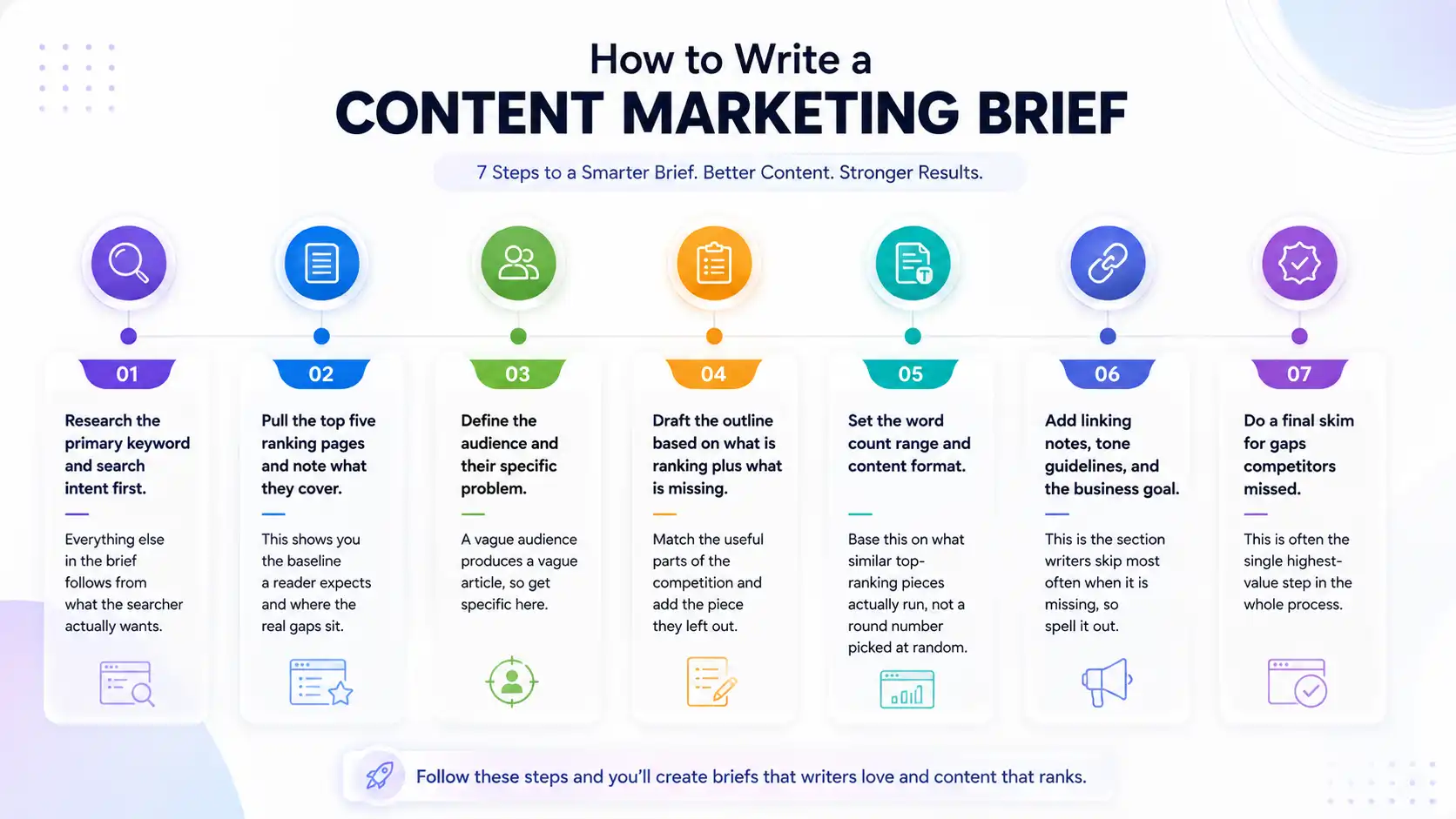
Building a content brief takes seven steps, from keyword research to a final read for gaps.
- Research the primary keyword and search intent first. Everything else in the brief follows from what the searcher actually wants.
- Pull the top five ranking pages and note what they cover. This shows you the baseline a reader expects and where the real gaps sit.
- Define the audience and their specific problem. A vague audience produces a vague article, so get specific here.
- Draft the outline based on what is ranking plus what is missing. Match the useful parts of the competition and add the piece they left out.
- Set the word count range and content format. Base this on what similar top-ranking pieces actually run, not a round number picked at random.
- Add linking notes, tone guidelines, and the business goal. This is the section writers skip most often when it is missing, so spell it out.
- Do a final skim for gaps competitors missed. This is often the single highest-value step in the whole process.
Following those seven steps gets you most of the way there, but a few common mistakes still trip up experienced teams.
Common Content Brief Mistakes to Avoid
The most common content brief mistakes are being too vague, too prescriptive, or too long to actually get read.
- Too vague. The writer guesses at angle, depth, and structure, and guesses are inconsistent by nature.
- Too prescriptive. Dictating every sentence removes the writer’s voice and turns the brief into a script nobody enjoys following.
- Missing search intent. A keyword picked without checking what the searcher wants sends the whole piece in the wrong direction.
- No linking notes. Without a list, writers either skip internal links entirely or scatter them in randomly.
- No defined success metric. If nobody agreed on what success looks like, nobody can tell if the piece worked.
- Running past two pages. A brief nobody reads is worse than no brief at all.
Fixing these mistakes is one thing. Doing it fast, every single time, is a different problem entirely.
How to Create Content Briefs Faster Without Losing Quality
The fastest way to create consistent content briefs is to stop retyping the same structure every single time. Most content teams write the same fifteen labels over and over, week after week, and that repetition is exactly the kind of task worth automating.
Picture a marketing lead who plans four articles a week. Typing “Working Title,” “URL Slug,” “Primary Keyword,” and a dozen more labels by hand, four times over, adds up to a real chunk of the week spent typing the same words instead of doing actual strategy work. That is the part worth fixing first.
Save your entire brief template as a snippet triggered by a short command like /brief, and the full structure appears in seconds instead of you retyping headers for the tenth time this week. Slashit’s snippet feature handles exactly this. One shortcut, one full template, every time you need it.
Dynamic template fields take it a step further by prompting you to fill in the audience, keyword, and word count as the snippet expands, so you are not hunting through placeholder text afterward. Dynamic templates turn a static block of text into something closer to a fill-in-the-blank form you finish in seconds.
Messy notes from a call or a voice memo rarely read like brief-ready language, and cleaning them up by hand eats time you do not have. Slashit’s AI rewrite feature turns rough notes into clear, brief-ready sentences in one pass.
Building a brief also means pulling competitor snippets, keyword lists, and stats from a dozen open tabs, and most clipboards only hold the last thing you copied. Clipboard history keeps everything you copy in one running list, so you can paste any of it back in without switching tabs again.
If you write and manage your own briefs solo, this shift matters even more, since freelancers rarely have an ops team building templates for them in the background.
With the process fast and repeatable, the last thing worth covering is the handful of questions people ask most often about content briefs.
Content Marketing Brief FAQs
What is the difference between a content brief and a content outline?
A content brief covers the entire assignment, while a content outline covers only the structure of headings inside the piece. The outline usually lives inside the brief as one section, not as a separate document.
How long should a content marketing brief be?
A content marketing brief should run one to two pages for most blog posts and articles. Longer briefs tend to go unread, so keep only the fields a writer will actually use.
Who should write the content brief, the strategist or the writer?
A content strategist or editor usually writes the brief, since they hold the keyword research and business goals. That said, an experienced writer working alone can build one from the same template without an editor involved.
Does a content brief need a target keyword?
Yes, if the piece is meant to rank in search. The keyword sets the direction for the title, the headings, and the search intent the rest of the brief builds around.
What tools help create content briefs faster?
Keyword tools like Ahrefs or Semrush handle the research side of a brief. A text expander like Slashit handles the repetitive side, turning your brief structure into a reusable snippet instead of a blank page every time.
Can one brief template work for every type of content?
Mostly, yes, with small adjustments. A standard blog brief covers most articles, but formats like thought leadership pieces or video scripts benefit from one or two extra fields, such as a point-of-view note or a shot list, layered on top of the same base template.
Final Thoughts
A good content marketing brief template turns a blank page into a five-minute setup, and that is the real value here. Get the structure right once, and every future article starts with clear direction instead of guesswork.
Start with the free template above, adjust the fields to match how your team actually works, and keep it to one page. If you want to see how a saved snippet and a dynamic template change how fast you get from idea to draft, Slashit’s pricing page shows the free plan you can start with today.
// more articles
 Template
 AI Dynamic Templates: What They Are and How They Work
AI dynamic templates combine reusable structures with smart placeholders. Learn how they work, real examples, and how to build your own today.
 Template
 Corporate Trainer Session Outline Template: With Examples
A ready corporate trainer session outline template with a timed agenda, clear objectives, and a materials checklist you can copy today.
 Alternatives
 Best Productivity Tools for Managers in 2026 (Tested and Compared)
A clear, no-fluff guide to the best productivity tools for managers in 2026, from task apps to tools that cut daily writing time in half.

// blog updates