How to Write a Discovery Call Follow-Up Email That Gets Replies


Founder & CEO, Slashit App
You just wrapped your fourth discovery call of the day. The prospect seemed interested, you took notes on your screen, and now you’re staring at a blank email trying to remember if they said “Q3” or “Q4” for their timeline.
This is the moment most deals quietly stall. Not because the product was wrong or the pricing was off, but because the follow-up email showed up late, sounded generic, or never showed up at all.
A discovery call follow-up email is the bridge between a good conversation and a real next step. Get it right and you look like the rep who actually listened. Get it wrong and you’re just another name in a crowded inbox.
For an account executive juggling multiple accounts, the stakes are higher than they look. Prospects rarely tell you a deal went cold. They just stop replying, and by the time you notice, the window to re-engage them has usually closed.
This guide walks through the timing, structure, and wording that make a discovery call follow-up email work, plus a full template you can adapt for your next call. We’ll also cover what to do when a prospect goes quiet, since that happens more often than any AE would like.
How Soon Should You Send a Discovery Call Follow-Up Email?
Send your discovery call follow-up email the same day, and never later than 24 hours after the call ends. Speed matters more than polish here.
Think about what your prospect’s day looks like. They probably took two or three other calls that week, maybe that same day. Your conversation is fresh right now, but it won’t stay that way. Every hour you wait, your prospect’s memory of the specific details you discussed gets fuzzier, and your email has to work harder to jog it back.
The data on this is blunt. A widely cited analysis of B2B lead response times found that the average company takes around 42 hours to follow up with a prospect, and firms that respond within the first hour are roughly seven times more likely to qualify that lead than those who wait even one hour longer.
The same research puts the odds even higher against slow follow-up: waiting a full 24 hours makes a company about 60 times less likely to qualify the lead compared to responding within the first hour. Discovery call recaps aren’t quite the same as an inbound lead response, but the underlying mechanic is identical: interest decays fast, and the first rep to show up organized usually wins the deal.
There’s a practical reason for speed too. A same-day follow-up signals that you’re organized and responsive, which is exactly the impression you want to leave with someone deciding whether to trust you with their budget. A follow-up that lands two days later signals the opposite, even if the content is identical.
If you can, send it within an hour or two of hanging up. Your notes are still sharp, the prospect’s inbox probably isn’t flooded yet, and you avoid the trap of letting “I’ll get to it later” turn into “I’ll get to it tomorrow.” Set a timer if you have to. The goal is simple: land in their inbox while your call is still the most recent thing on their mind.
Timing gets your email opened. What’s inside it is what actually moves the deal forward, so let’s break down the parts that matter.
What Should a Discovery Call Follow-Up Email Include?
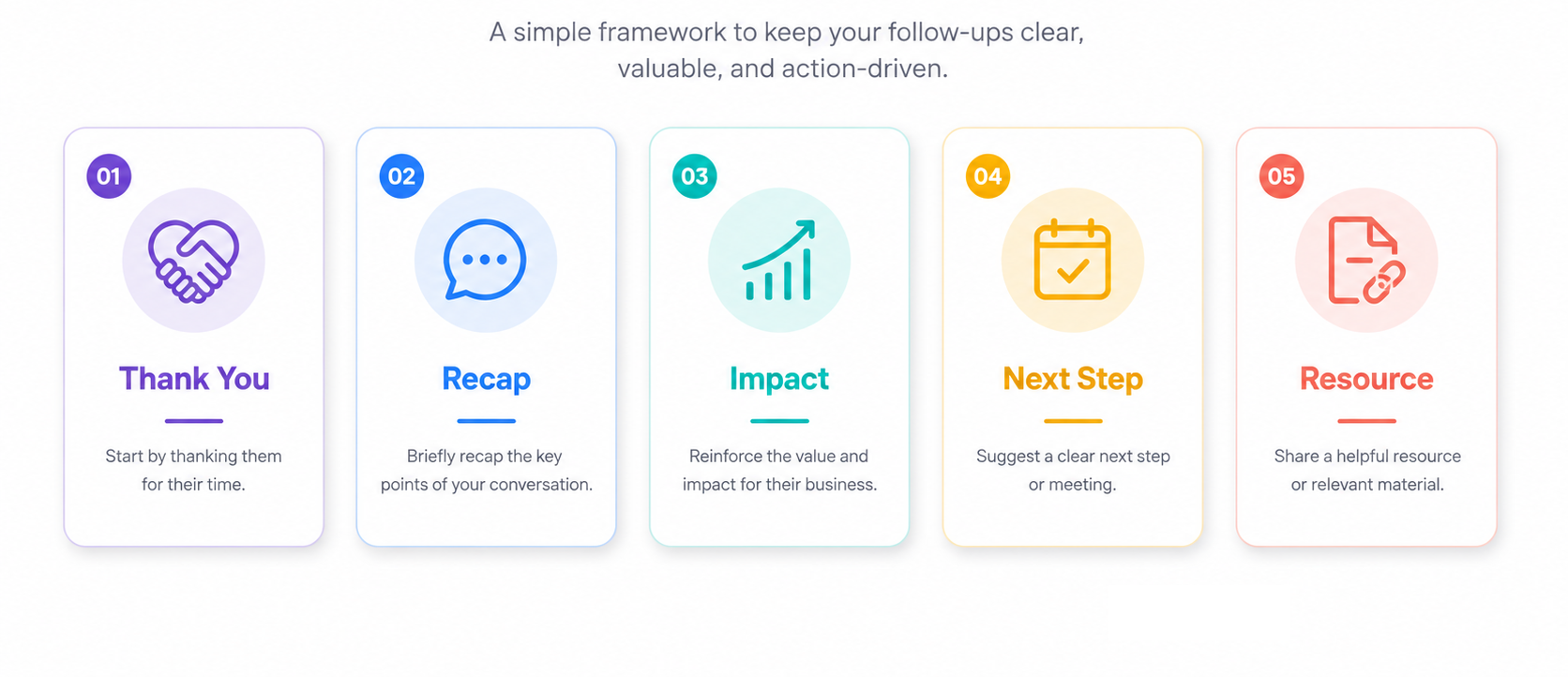
Every effective discovery call follow-up email includes a thank-you line, a recap of what you learned, confirmation of next steps, one relevant resource, and a clear call to action. Skip one of these and the email gets weaker, even if it still reads fine.
Here’s what each part is doing and why it earns its place:
A short, specific thank-you- Skip “Hope you’re having a great week.” They just spent 30 minutes with you, so acknowledge that directly. Something like “Thanks for walking me through your team’s reporting process today” works better because it proves you were paying attention.
A recap of their pain points, in their words- This is the part that does the heaviest lifting. Pull three to five specific things they told you, using their language rather than your product’s marketing terms. If they said “we’re drowning in manual data entry,” write that, not “inefficient workflows.”
Confirmation of the business impact- Tie the pain point to a number if you have one. Time saved, cost avoided, revenue at risk. Even a rough estimate shows you’re thinking about their outcome, not just your quota.
A clearly stated next step with a date- Vague endings like “let’s talk soon” put the burden back on the prospect to figure out what happens next. Give them a specific day, time, and purpose for the next touchpoint.
One resource, chosen carefully- A case study from a similar company or a short product overview works well here. Sending three or four links dilutes the message and looks like you’re padding the email. Pick the one thing most relevant to what they said.
Notice what’s missing from this list: a hard sell. A discovery call follow-up isn’t the moment to push pricing or close. It’s the moment to prove you understood the conversation and to make the next step obvious. Trying to squeeze a pitch into this email usually backfires, since it signals that the recap was just a setup for a sales push rather than a genuine summary of what the prospect told you.
It also helps to keep the tone conversational rather than corporate. Prospects can tell the difference between an email that sounds like it came from a person who was on the call and one that reads like it was pulled from a battlecard. Write it the way you’d explain the call to a colleague, then tighten it up. Once you’ve nailed the structure, the next detail worth getting right is the one line that determines whether your email gets opened at all.
What Makes a Good Subject Line for a Follow-Up Email?
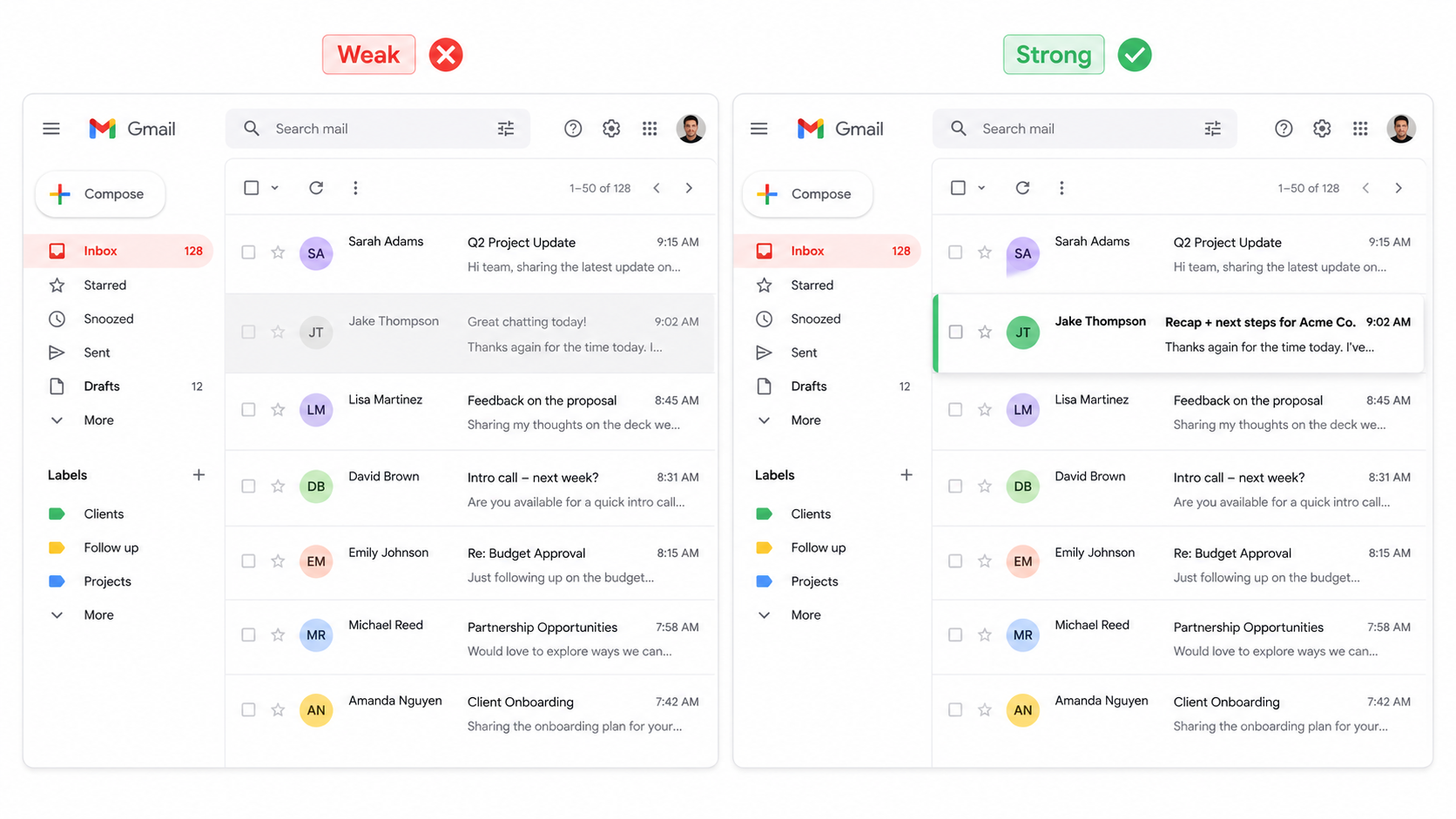
Your subject line should tell the prospect exactly what the email contains before they open it, not tease them into clicking. Vague subject lines get buried, especially in inboxes that already have 40 unread messages by lunchtime.
Compare these two approaches:
- Weak: “Great chatting today!” or “Following up”
- Strong: “Recap + next steps for [Company Name]” or “[Company Name] discovery call: what we covered and what’s next”
The strong versions work because they front-load the purpose. A busy VP scanning their inbox on their phone can decide in half a second whether this email needs attention now or can wait. That clarity works in your favor, since it means your email doesn’t get mentally filed under “read later,” which usually means “never.”
Keep it under 60 characters if you can, since longer subject lines get cut off on mobile. And skip the exclamation points. Enthusiasm reads better in the body of the email than in the subject line, where it can come across as salesy before the prospect has even opened the message.
With the subject line handled, you’ve got someone’s attention. Now here’s a template that pulls the structure and subject line advice together into something you can actually send.
What Does a Good Discovery Call Follow-Up Email Template Look Like?
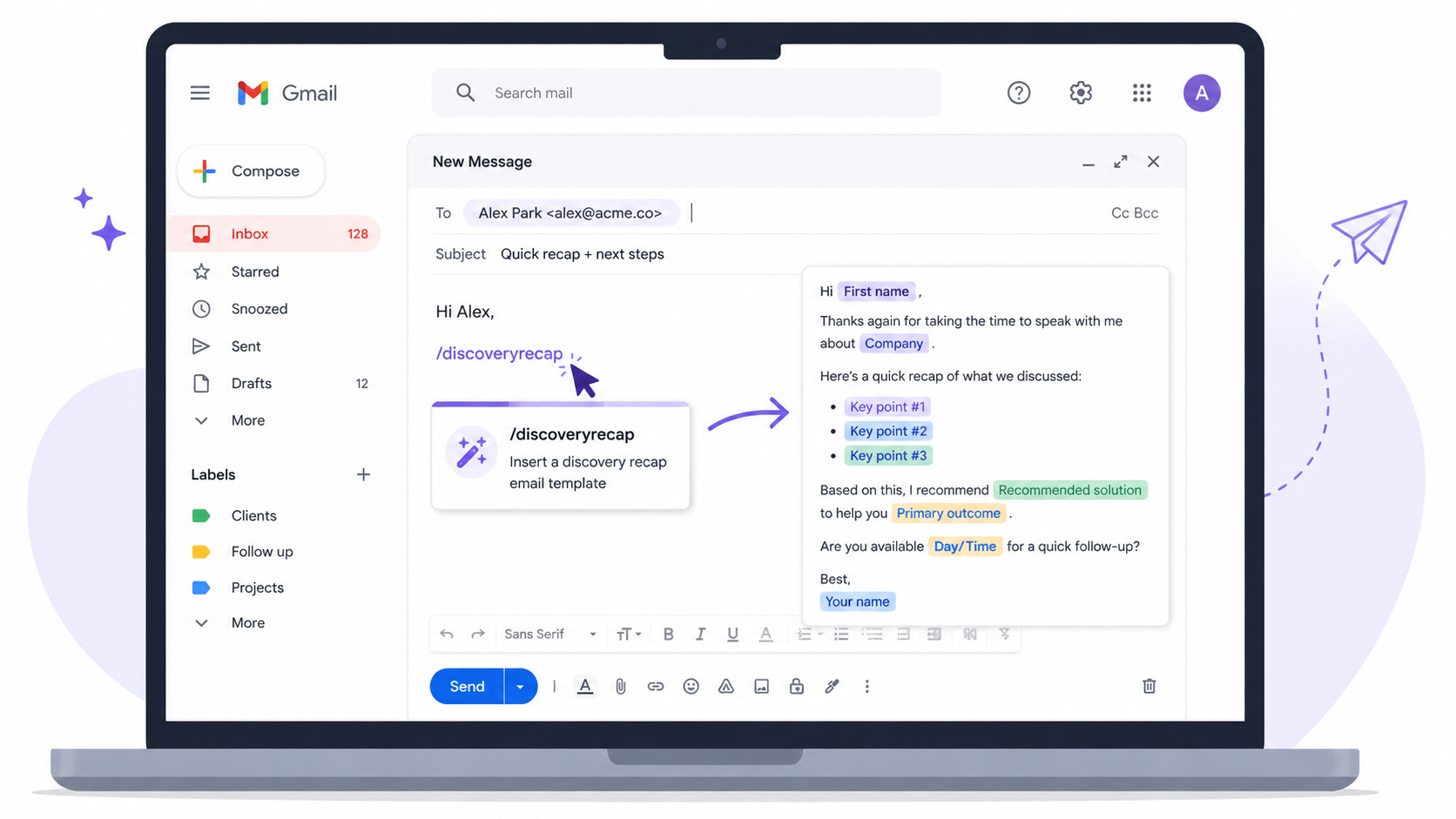
A good template gives you the frame so you can focus on the details that make the email feel specific to that one prospect. Here’s a version built around the five-part structure above.
Subject: Recap + next steps for [Prospect Company]
Hi [Name],
Thanks for taking the time today. I appreciated hearing more about how your team is handling [specific challenge they mentioned], especially the part about [specific detail from the call].
Here’s what I took away from our conversation:
- The priority: [Their main goal, in their words]
- The impact: Solving [pain point] could save your team roughly [time or cost estimate], freeing up bandwidth for [strategic priority they mentioned]
- The timeline: You’re aiming to have something in place by [timeframe they gave you]
I’m attaching [case study or resource] that shows how a similar team tackled [specific pain point]. Take a look when you get a chance.
Next step: I’m looking forward to our [call type] on [day, date, time], where we’ll [what will happen, like a tailored demo or a pricing conversation].
Let me know if anything shifts before then.
Best, [Your name] [Your title] [Scheduling link]
Notice this template leaves specific blanks rather than generic ones. That’s intentional. The version of this email that wins the deal is the one where the prospect reads the recap and thinks “yes, that’s exactly what we talked about,” not one where they can tell you swapped in their company name and nothing else.
This is also where most reps quietly lose time. If you’re rebuilding this structure by hand on every call, you’re retyping the same thank-you line, the same bullet format, and the same sign-off dozens of times a week. A dynamic template with placeholders solves this specific problem. You build the recap structure once, and each time you expand it, it prompts you to fill in only what actually changes: the pain point, the number, the date. The structure stays consistent. The thinking that makes it personal still comes from you.
Even with a solid template in hand, there are a few habits that quietly undo all of this work. Let’s look at what to avoid.
What Mistakes Quietly Kill a Follow-Up Email’s Momentum?
Most follow-up emails fail not because they’re badly written, but because they skip a detail, arrive too late, or ask the prospect to do work that should’ve been yours. Here are the five that show up most often:
- Sending a generic recap- If your email could apply to any prospect in that industry, it doesn’t prove you listened. Specificity is what separates a follow-up that gets remembered from one that gets skimmed.
- Burying the next step- If the prospect has to reread your email to figure out what happens next, you’ve lost some of the momentum from the call. State the next step once, clearly, near the end.
- Attaching too many resources- One well-chosen case study beats three generic links. Extra attachments make the email feel like a brochure instead of a personal note.
- Letting the email sit for a day or two. As covered earlier, delay is the single biggest killer of follow-up effectiveness. A great email sent late still underperforms a decent one sent fast.
- Skipping the CRM update- This one doesn’t affect the prospect directly, but it affects you. If you don’t log the call details right after hanging up, you’ll be relying on memory for your next touchpoint, and memory fades fast when you’re juggling ten accounts.
There’s a sixth mistake worth naming separately, since it’s easy to miss: treating every discovery call follow-up as its own writing project. If you’re on eight or ten calls a week, rebuilding the email structure from a blank page every single time eats up hours that could go toward actual selling. The fix isn’t to write less carefully. It’s to stop rewriting the parts that don’t need to change.
Most of these mistakes come down to the same root cause: reps are moving fast between calls and don’t have a reliable system for capturing details and turning them into a personalized email quickly. That’s a real constraint, and it’s worth solving directly rather than just trying to work harder.
How Do You Stop Rewriting the Same Follow-Up Email Every Time?
The fastest way to send faster, better follow-ups is to separate the parts of the email that stay the same from the parts that change with each prospect, so you’re only typing the details that actually matter. Trying to write every follow-up from a blank page is what leads to delay and generic recaps in the first place.
We hear a version of this constantly from sales teams: the recap itself was never the hard part. It was retyping the same structure, call after call, that quietly ate the afternoon.
One sales manager who rolled out shared templates across her team put it simply: once the best-performing recap format was saved and shared, new reps started sending better follow-ups in their first week than veterans had been sending on their own. The structure did the heavy lifting; the rep just filled in what was actually different about that call.
A few habits help here:
- Keep a running template for your most common call type. If most of your discovery calls follow a similar structure, save the frame as a snippet so you’re not rebuilding the thank-you line and next-steps format every single time. Type a short code, and the full structure appears with blank fields ready for the details that change per prospect.
- Log details during the call, not after. Jot down the pain points and numbers as the prospect says them. Trying to reconstruct them from memory 20 minutes later is where accuracy slips.
- Use a tool that expands your structure with a short code. This is where a text expander like Slashit fits in naturally. It works directly inside Gmail, Outlook, Salesforce, or whatever you’re typing into, so there’s no separate app to switch to mid-email.
- Keep a clipboard history for the details you reuse often. If you’re pasting the same case study link or calendar link into multiple emails a day, clipboard history that remembers your recent copies saves you from digging back through old emails to find them.
- Use an AI rewrite pass for tone, not content. Once your recap is drafted, running it through an AI rewrite tool can tighten the phrasing or adjust the tone for a more formal or more casual prospect, without changing the substance of what you’re saying: highlight the paragraph, hit a hotkey, and pick “more formal” or “shorten.”
None of this replaces the thinking that makes a follow-up feel personal. It just removes the repetitive typing around that thinking, so you can send a specific, well-structured email in the same amount of time it used to take to write a generic one.
Even with a fast system in place, you’ll still run into the question every AE asks eventually: what happens if the prospect just doesn’t reply?
What Should You Do When a Prospect Doesn’t Respond to Your Follow-Up?
Give it three to five business days, then send one short, low-pressure nudge rather than repeating your original recap. Silence after a discovery call doesn’t automatically mean the deal is dead. It often just means the prospect got pulled into something else.
A few guidelines for this situation:
- Don’t send the same email twice- If your first follow-up was a full recap, your second touch should be short. Something like “Wanted to bump this back to the top of your inbox, happy to answer any questions before our next call” respects their time and doesn’t feel repetitive.
- Switch channels if email goes quiet- A quick, casual message on LinkedIn or a short phone call can re-engage someone who’s simply buried in email. Different channels get noticed differently.
- Cap it at two or three attempts- Persistent follow-up is good. Repeated follow-up with no new information starts to feel like pressure. If you’ve sent a recap and one gentle nudge with no response, it’s usually time to check in less frequently or move the account to a longer-term nurture cadence.
- Give them an easy out- Asking directly, “Is this still a priority for you right now, or should I check back in a quarter?” often gets a more honest answer than another generic “just following up” message.
Frequently Asked Questions
How soon should I send a discovery call follow-up email?
Same day if possible, and no later than 24 hours after the call. The sooner it lands, the more of the conversation the prospect still remembers.
What should a discovery call follow-up email include?
A specific thank-you, a recap of the prospect’s pain points in their own words, confirmation of the business impact, a clear next step with a date, and one relevant resource.
How long should the email be?
Short enough to read in under a minute. Bullet points for the recap help keep it scannable rather than dense.
What if I don’t have all the details from the call?
Send what you have and note that you’ll follow up with anything outstanding. A slightly incomplete recap sent on time beats a perfect one sent two days late.
Should I CC my manager or another stakeholder on the follow-up?
Only if the call itself involved them or the prospect asked for it. Adding people the prospect didn’t expect can make the email feel like it’s escalating internally, which isn’t the impression you want right after a first conversation.
Is it okay to reuse the same template for every prospect?
The frame can stay the same, but the recap details always need to be specific to that call. A template that saves you time on structure is useful. A template that gets sent with only the company name swapped in usually reads as generic, and prospects notice.
Keep the Structure, Skip the Retyping
A strong discovery call follow-up email isn’t complicated once you know the parts it needs: a specific thank-you, a recap in the prospect’s own words, a number that ties the pain point to real impact, one resource, and a next step with a date attached. None of that is hard to write once.
The harder part is doing it consistently, call after call, week after week, without letting speed or personalization slip as your pipeline fills up. That’s less a writing problem than a systems problem, and it’s the one most reps never actually fix. They just get better at typing fast under pressure, which only works until the day it doesn’t.
A tool like Slashit is built for exactly that gap: expand your recap structure with a short code, fill in only what’s actually different about that call, and run it through an AI rewrite pass if the tone needs adjusting, all without leaving your inbox. If you’re building out more of your outreach stack, it’s also worth comparing text expander tools to see what fits your workflow.
// free tools for this
// more articles
 Productivity
 10 Best Grammarly Alternatives in 2026: Free and Paid
Comparing the best Grammarly alternatives for 2026 by price, AI customization, and use case, so you can find the right fit fast and skip the guesswork.
 Productivity
 Text Expander for Founders: Save Hours Every Week
A text expander for founders turns investor updates, cold outreach, and hiring replies into one hotkey. Compare tools, get templates, and set up in minutes.
 Productivity
 Text Expander for Managers: Stop Retyping the Same Messages
A text expander for managers turns repeated messages into instant shortcuts. See how tools like Slashit save managers hours every week.

// blog updates